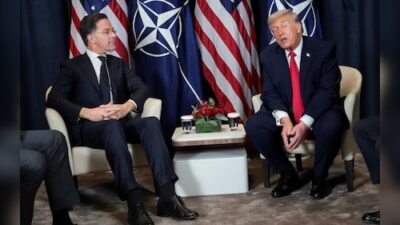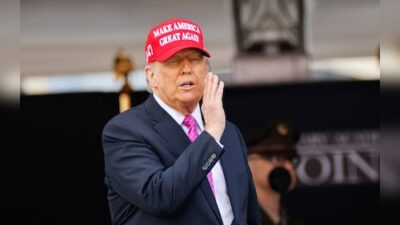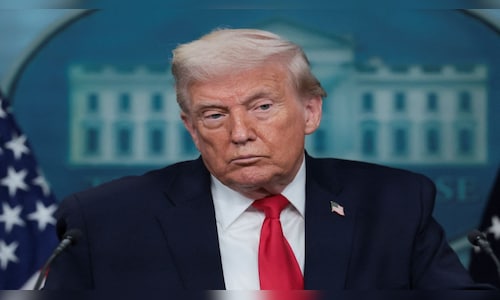
In his address, Trump spoke of an “economic miracle” in the US, asserting that his policies had curbed inflation, stimulated growth, and rejuvenated American manufacturing within just a year of his administration. He referred to the current economic landscape as “phenomenal news,” contrasting it with the “stagflation” he attributed to the previous administration. Trump defended a significant pivot in energy policy that prioritizes domestic energy production, advocates for new plant openings, and dismisses wind power approvals, stating that tax cuts and higher tariffs are key elements of his economic strategy.
Trump linked trade and security in his remarks, particularly regarding Greenland and Europe. He posited that US security interests necessitate control over Greenland and cautioned Europe of repercussions if Washington’s demands are not fulfilled.
In an interview with CNBC-TV18, Meera Shankar noted that Europe’s reaction signifies a substantial departure from historical norms. “This is not merely a transition, but a rupture or disruption of the old order,” she remarked, citing the unusually strong opposition from European leaders.
Harsh Pant, Vice President at the Observer Research Foundation, stated that Trump has been explicit and calculated in presenting his views. “Mr. Trump has established his position very clearly,” he noted, emphasizing that the rationale behind Greenland aligns with US national security norms. Pant conveyed that Trump’s underlying message to Europe is transactional: partner with Washington or face economic and political ramifications.
Pant also highlighted that Europe’s response is limited by internal divisions and fragile leverage. Although mechanisms like reciprocal tariffs, restricted market access, or delays in trade agreements exist, he emphasized that “it is not entirely clear that Europe has the influence to act,” especially concerning national security and NATO matters. This ambiguity, he indicated, will shape negotiations in the near future.
Also Read: Davos 2026 | Trump hails ‘economic miracle’, says US growth outpacing global forecasts
For India, the implications from Davos are both clear and daunting. Shankar remarked that Trump’s speech reaffirmed that domestic political priorities will dominate US economic policymaking. “Globalisation is no longer the topic of the hour,” she observed, pointing out that US policies are increasingly reflective of American workers’ interests under the “Make America Great Again” agenda.
India will need to seek opportunities within this new framework, even amidst uncertain trade discussions with Washington. Simultaneously, progress on a trade deal with the EU could enhance India’s strategic maneuverability. If finalized, such an agreement would indicate that India has alternative markets and partners, potentially alleviating pressure in US negotiations at a time when global trade is becoming increasingly fragmented and transactional.
Below is the excerpt of the discussion.
Q: It’s been a long Donald Trump speech, and this was very much a Trump Davos. How do you see the statements Donald Trump made on Greenland, saying that he cannot defend Greenland just with a licensing agreement, that he needs to acquire it and own it to be able to defend it and support NATO in the future? He said he is looking at mediation and negotiation and does not want to use force. How does this set the tone ahead of his talks with European leaders on Greenland?
Shankar: For the first time, we have seen European leaders, instead of skirting around Trump — which has been their approach until now to avoid offending him — actually push back, and strongly at that, at least verbally. Whether it’s President Macron, the leaders of Belgium or Denmark, or Ursula von der Leyen, President of the European Commission, there is noticeable pushback from European leaders, signaling that the EU is preparing for a more autonomous position in the future. This is more than just a temporary transition; it signifies a break or disruption of the prior order.
Regarding Greenland, President Trump has not outright excluded the use of force until now. In this address, he called for negotiations while reiterating the US claim on Greenland and the rationale for its strategic importance. He has stated that he will not resort to excessive force, which he could have chosen to do, opening up a potential avenue for discussions among NATO allies, though it remains uncertain how NATO will react.
Trump added that Europe has an option: they can agree, and the US will appreciate it, or they can refuse, and the US will remember. “Remembering” could involve increasing tariffs if, by June, there is no advancement in the US acquisition of Greenland — from the current 10% to 25%, making it extremely challenging for Europeans to cope with.
Q: Harsh Pant, we saw a united Europe and very strong words from leaders like Emmanuel Macron and Canada’s Mark Carney. Do you think that with the threat of a trade bazooka, the EU and the UK will be able to stop Donald Trump?
Pant: Frankly, it’s uncertain. Mr. Trump has delineated his stance with precision. The reasoning he offers for Greenland is strategically sound as far as the US is concerned. He argues that Europe has not been fulfilling its role, hence the security architecture is deteriorating while America bears most of the burden, which he deems unsustainable. Therefore, his message is clear: concede Greenland, and we will manage it; otherwise, there will be repercussions.
The negotiations will revolve around these repercussions. When he asserts “if you say no, we will remember,” it signifies that America will present all options. While Europe has shown a commitment to push back against the US, existing internal divisions within the EU complicate the matter. Despite a newfound resolve to counter the US, it’s not entirely apparent that Europe possesses the means to act decisively.
Beyond trade measures, such as reciprocal tariffs, diminishing market access for the US in certain areas, or delaying the EU-US free trade agreement, Europe’s choices remain limited due to internal discord. The outcomes at the negotiating table will be fascinating to observe. Trump has crafted a compelling case and will reiterate it. However, it remains unclear if Europe can respond robustly, especially concerning national security and NATO.
Q: Ambassador Shankar, in just a few seconds, what are the cues for India? We still don’t have a trade deal with the US, and the mood in Delhi is uncertain. Trump has outlined priorities on energy, trade, migration, and a strong United States. What should India read into this?
Shankar: Globalisation is no longer the overriding theme. The US Commerce Secretary highlighted that policies are now guided by the interests of Western workers, particularly American workers. This forms the basis of Trump’s “Make America Great Again” agenda.
India must identify opportunities within this context. While it may not be straightforward, India has so far endured US tariffs. We also need to assess the likelihood of the India-EU trade deal materializing. Ursula von der Leyen noted there is still some ground to cover, but if it progresses — which appears probable — it could be finalized by January 26 and would represent the “mother of all trade deals.” This would signal that India has alternative options and markets, which might ease the pressure in US negotiations.
Watch accompanying video for entire discussion.