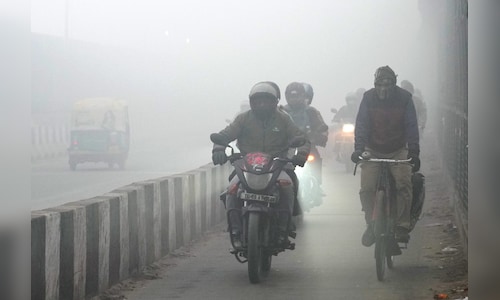
According to CPCB data accessed via its Sameer mobile application, the national capital recorded an overall AQI of 392 in the morning, firmly placing air quality in the “very poor” category.
Several locations, however, fell into the “severe” category. Anand Vihar reported one of the highest pollution levels, with an AQI reading of 444, as reported by news agency PTI.
Among the monitoring stations across the city, 19 reported “severe” air quality levels, while the rest showed “very poor” conditions. Under CPCB standards, AQI readings between 301 and 400 are classified as “very poor,” while values above 400 fall into the “severe” category.
Dense smog blankets Delhi
Residents awoke to a thick layer of smog, which severely reduced visibility across many parts of the city. Images from areas like Anand Vihar illustrated roads and neighborhoods engulfed in thick haze, as pollution levels exceeded the 400-mark in several locations, as reported by News18.
#WATCH | Delhi | Visuals from the Akshardham area show a layer of smog enveloping the national capital.
AQI (Air Quality Index) around the area is 445, categorised as ‘Severe’, as reported by CPCB (Central Pollution Control Board). pic.twitter.com/oJ28FHa4Az— ANI (@ANI) December 28, 2025
The pollution situation had already declined by the evening of Saturday, December 27, when the overall AQI reached 390.
Numerous areas in Delhi-NCR reported even higher readings, including Patparganj at 431, Nehru Nagar at 442, Shadipur at 429, Sirifort at 402, and RK Puram at 412, indicating pervasive “severe” air quality.
Travel disruptions amid low visibility
The smog, in conjunction with winter fog, led to reduced visibility and disruptions in transportation. Several trains experienced delays, with reports emerging from New Delhi Railway Station highlighting hazy conditions around the area, as noted by PTI.
The Delhi airport issued a fog advisory for travelers. In a post on X (formerly Twitter), the airport stated, “All flight operations are continuing normally as visibility at the airport improves. Passengers are requested to contact their respective airlines for the latest flight information. Please be assured that our on-ground officials are available across all terminals to provide necessary support.”
#WATCH | Visibility improves at the runway at IGI airport as early morning fog starts to dissipate across Delhi-NCR.
Delhi Airport issued a passenger advisory at 9 am stating, “All flight operations are continuing normally as visibility at the airport improves. Passengers are… pic.twitter.com/I2jixjEA2v— ANI (@ANI) December 28, 2025
Cold weather worsens pollution
The India Meteorological Department (IMD) recorded a minimum temperature of 6.3 degrees Celsius on December 28, approximately 0.5 degrees below the seasonal average, with humidity at 71% at 8.30 am, according to PTI.
The maximum temperature is anticipated to reach around 21 degrees Celsius, with mainly clear skies forecasted. According to the weather agency, calm winds, cold conditions, and dense fog are trapping pollutants near the surface.
In response, the Commission for Air Quality Management (CAQM) implemented Stage III measures under the Graded Response Action Plan (GRAP), including restrictions on construction and industrial activities, while measures like the “No PUC, No Fuel” rule remain in effect.
#WATCH | Delhi | Visuals around India Gate as a layer of toxic smog covers the national capital.
AQI (Air Quality Index) around the area is 378, classified as ‘Very Poor’, as reported by CPCB (Central Pollution Control Board). pic.twitter.com/FJF7ShS39g— ANI (@ANI) December 28, 2025
Health advisories continue to recommend that vulnerable groups limit outdoor activities during periods of “very poor” air quality, as noted by News18.