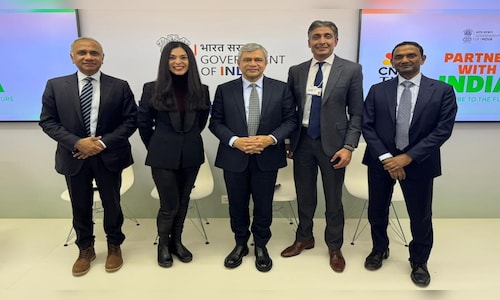
In an exclusive interview with CNBC TV18’s Managing Editor Shereen Bhan, Ashwini Vaishnaw detailed the figures. India has already secured a commitment of $70 billion from major players such as Google, Microsoft, and Amazon.
He added that the next year could bring in new commitments ranging from $50 to $80 billion for AI Infrastructure.
The minister made these remarks at the CNBC TV18 Davos Dialogue, which convened a roundtable of prominent industry leaders including TCS CEO K Krithivasan, Infosys CEO Salil Parekh, Wipro Executive Chairman Rishad Premji, Cisco’s President and Chief Product Officer Jeetu Patel, RPG Group Vice Chairman Anant Goenka, and ReNew Power CEO Sumant Sinha.
Infrastructure is one of the five essential pillars for India to advance in the AI sector, with applications, large language models, semiconductors, and power making up the other four.
The Narendra Modi administration is hopeful that the recent liberalization of the nuclear energy sector through the SHANTI Act, which was recently passed by Parliament, will help meet the surging power demands driven by the increasing adoption of AI.
Under the IndiaAI Mission, the Central government has selected 12 startups to develop sovereign foundational large language models (LLMs), ranging from 50-120 billion parameters, which can operate on small GPU clusters, to deliver AI services at lower costs.
The results under real-world testing have been remarkable, Vaishnaw remarked.
The Indian government plans to finance the development of applications and solutions, relying on Indian models, to ensure widespread technology adoption.
There will be numerous AI use cases available for farmers, MSMEs, and students, which may not be commercially feasible, Vaishnaw explained, providing justification for the government’s investment in AI initiatives.
Vaishnaw hopes the industry will assist in skill development for youth and establish a curriculum for students to cultivate a robust talent pipeline.
According to him, tangible progress in the five pillars will also attract semiconductor investments.
Read more: The missing AI edge in India is a lost opportunity and a risk