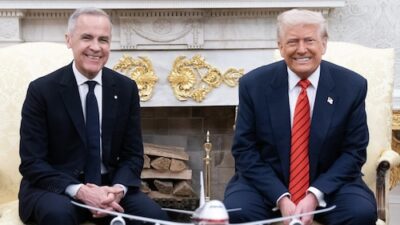
Rajiv Memani, President of the Confederation of Indian Industry (CII), remarked that global markets stabilized following US President Donald Trump’s withdrawal of the suggested 10% tariff on Greenland, alleviating investor fears.
“Currently, people are relieved that this won’t escalate into a major conflict,” he stated.
In an interview with CNBC-TV18’s Shereen Bhan, Memani pointed out that geopolitical instability was a major topic of conversation, while AI and its uses were prominent in private consultations.
“As you walk along the promenade during one-on-one meetings, AI appeared to be a significant focus, with its applications becoming increasingly vital,” he explained.
Memani further noted that nations are concentrating more on establishing new trade relationships, creating avenues for India to broaden its partnerships. He referenced the India–EU Free Trade Agreement (FTA), anticipated to be finalized on January 27, as a means to access the European market and attract investments.
“It unlocks the entire EU market,” he asserted. Regarding US trade relations, Memani acknowledged that timelines are still unclear, although President Trump has suggested a “good deal” could be on the horizon.
In terms of domestic policy, Memani urged that Budget 2026 should boost reforms and enhance domestic manufacturing. He proposed a bold disinvestment initiative, aiming for ₹750 billion to ₹1 trillion, to finance capital expenditures and improve competitiveness.
Meanwhile, Suneeta Reddy, Managing Director of Apollo Hospitals, underscored the healthcare challenges and opportunities in India. She described the country’s goods and services tax (GST) framework for healthcare as “complicated” and mentioned it may not be included in Budget conversations.
Reddy stated that AI has become essential for businesses, especially in healthcare. “AI is now mainstream. There’s no escaping AI,” she emphasized, stressing the importance of reskilling India’s workforce.
Additionally, she pointed out preventive healthcare as a crucial investment area, cautioning that non-communicable diseases could incur costs of $4 trillion for India, while highlighting opportunities in medical manufacturing and India’s ability to supply other emerging markets efficiently and cost-effectively.
(Edited by : Anshul)
First Published: Jan 22, 2026 3:34 PM IST