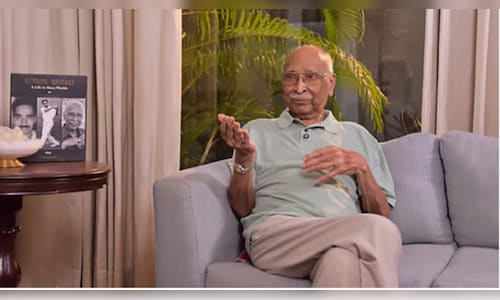
Gopinath, who was the second oldest cricketer globally after Australian great Neil Harvey (97), is survived by his wife, children, and grandchildren.
With his passing, Mumbai’s 95-year-old Chandrakant Patankar has assumed the title of the country’s oldest cricketer. He participated in one Test match, against New Zealand in 1955.
The death of Gopinath signifies not only the loss of India’s oldest living Test cricketer but also the final personal link to a remarkable chapter in the country’s esteemed cricketing heritage.
Four years ago, Gopinath sparkled with nostalgia as he reminisced about India’s first-ever Test victory, an innings and eight-run triumph over England at Chepauk in 1952.
“See! That’s the advantage of a long life. You can keep adding and rewriting your story. Everyone will give me the benefit of age, but you know, the benefit of doubt always goes to the batsman, right?” he remarked.
Even at 92, Gopinath was an exceptional storyteller, sharing entertaining anecdotes from his brief eight-Test career in India whites.
Among the finest of these were tales of those four illustrious days in what was once Madras, now Chennai.
In the realm of statistics, Gopinath’s figures will always appear modest — eight Tests yielding 242 runs, including one fifty.
However, true to his character, Gopinath never held bitterness over a brief career that began promisingly with scores of 50 and 42 against England at Brabourne in 1951.
Nonetheless, a rather challenging tour to England later in 1952 brought its own set of troubles, resulting in him being out of the team more often than not.
Nevertheless, Gopinath remained a vital player in domestic cricket, accumulating runs and frequently captaining Madras.
He finished with 4259 runs from 83 matches at an average of 42, along with nine centuries.
A highlight of his career was a dazzling, stroke-filled 175 in the second innings while touring New Zealand for South Zone.
The Kiwis fielded notable players, including Bert Sutcliffe, John Reid, John Alabaster, and Parke Zinzan Harris, the father of former NZ all-rounder Chris Harris.
Even though South lost the match, Gopinath’s innings garnered admiration from the Antipodeans.
“Reid and Sutcliffe later approached me in the dressing room, and we shared an enjoyable conversation about the game. The competition lasted only until the day’s last ball; after that, we all wanted to get to know each other better and have a good time,” he recalled.
After retiring, Gopinath took on the role of chief national selector and managed the Indian team during their 1979 tour to England.
This tour became famous for India’s audacious chase of 438, led by Sunil Gavaskar’s remarkable 221. However, India managed only 429 for eight, leading to a draw at The Oval.
This match held a special place in Gopinath’s memory, and he was always ready to praise Gavaskar’s technical finesse.
However, Gopinath wasn’t a person content to dwell in the past. He actively followed contemporary cricket and had a fondness for the IPL and the Chennai Super Kings.
“Everything changes with the team, and cricket is no exception,” Gopinath would remark, remaining a devoted fan of Mahendra Singh Dhoni.
“I support CSK mainly because of MSD—not just his cricketing intelligence, but how he conducts himself on the field. He doesn’t strut around or jump ten feet high.
“He refrains from making any rude gestures. It makes me uncomfortable when I witness that,” Gopinath commented last year during a CSK event.
His words encapsulated Gopinath’s essence—a fiercely competitive cricketer on the field and a true gentleman off it.