development agenda, a pressing question arises: what does it truly require to implement AI at scale within public systems?
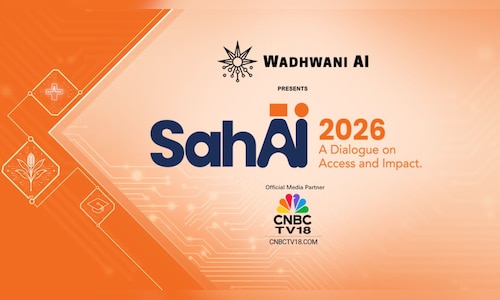
This inquiry shaped SahAI, Wadhwani AI’s principal one-day symposium
held in New Delhi as an adjunct event to the India-AI Impact Summit 2026.
Designed as a hands-on guide rather than a display of theoretical concepts,
SahAI brought together policymakers, practitioners, researchers, and
ecosystem partners to explore how AI is already being employed across
healthcare, agriculture, education, and social impact—and what needs to change
for these implementations to be sustainable.
Throughout the sessions, a clear message surfaced. The value of AI in India will not be
measured by novelty or speed, but by its capacity to enhance existing
systems, assist frontline workers, and function responsibly at a population
scale.
Framing AI for Public Service: From Technology to Seva Bhaav
Opening the day’s proceedings, Shekar Sivasubramanian, Head of
Wadhwani AI, emphasized the concept of artificial intelligence as an
augmentative tool rather than an isolated solution. He portrayed AI
deployment in public systems as an act of seva bhaav—service with
responsibility—where long-term stewardship is as critical as technical
proficiency.
The goal, he clarified, is not to tout intelligence but to enable
people-focused advancement: minimizing workload, enhancing access, and
building trust in public service delivery across health, agriculture, and
education.
AI-Empowered Healthcare: From Rural Outreach to Urban Excellence
The AI-Empowered Healthcare panel, led by Dr. Alpan Raval, Chief
AI/ML Scientist at Wadhwani AI, examined how AI can broaden clinical reach
without compromising safety or accountability. This discussion melded
insights from government, clinical practice, and public health systems,
including Dr. Smriti Singh, State TB Officer, National Health Mission, Madhya Pradesh; Dr. Raghuram Rao, Deputy Director, TB Division, Ministry of Health &
Family Welfare; Dr. Himanshu Chauhan, Additional Director and HoD, Integrated Disease Surveillance Program, National Centre for Disease Control,
Shashi Mansotra, Scientist, Centre for Development of Advanced Computing,
Mohali; Suhel Bidani, Digital and AI Lead, Gates Foundation; and Dr. Radhika
Tandon, Chief & Professor of Ophthalmology, Dr. Rajendra Prasad Centre for
Ophthalmic Sciences, AIIMS, New Delhi.
Shri S. Krishnan, Secretary of the Ministry of Electronics and Information Technology (MeitY), outlined four guiding principles for AI adoption in
healthcare: availability, affordability, accessibility, and quality. He stressed
that India’s challenge lies not in the abundance of human resources but in their uneven
distribution. In this light, AI’s function is to bridge gaps between rural and urban
systems, not to supplant medical decision-making.
Discussions covered implementations in tuberculosis screening, disease
surveillance, clinical decision support, and telemedicine—often integrated into
national platforms like e-Sanjeevani. Dr. Smriti Singh provided examples of
AI-enabled mobile TB screening initiatives, and Dr. Raghuram Rao
highlighted the transition to active case detection and AI-driven risk
stratification to lessen transmission and mortality.
Throughout the conversation, the emphasis remained on validation, robust datasets,
and deployment at state and national scales—the point at which AI
operates as public health infrastructure rather than merely a pilot
intervention.
Transforming Agriculture: Precision, Access, and Inclusion
The Transforming Agriculture panel focused on a sector where timing, trust, and local context drive outcomes.
Moderated by J.P. Tripathi, Director of Agriculture at Wadhwani AI,
the panel included Dr. Malvika Chaudhary, Global Team Leader, Digital Tool
Promotion, CABI; Paritosh Anand, Chief AI and Digital Officer, Wadhwani
Centre for Government Digital Transformation; Sumit Roy, Assistant General
Manager, Palm Oil Programme, Solidaridad Network; Dr. Ashwini Gajarushi,
Engineering Manager, IIT-Bombay; Nishant Gupta, Social and Environmental
Impact Advisor at Walmart.org; and Dr. Kuppusamy Ramesh, Principal
Scientist, ICAR-CICR, Nagpur. They discussed AI applications from
pest surveillance and precision farming to digital advisory systems. A prevailing concern was the limited bargaining power of small farmers, especially at the mandi level, and how AI could mitigate information asymmetry via
improved forecasting and decision support.
A thorough focus was given to inclusion. The women in agriculture
segment showcased how AI-powered chatbots and advisory tools, provided in
local languages, can empower women as digital intermediaries within farming
communities. Successful examples emerged from Tamil Nadu, where women farmers
are becoming “digital champions,” utilizing AI tools to disseminate agricultural
practices and boost productivity.
The panel highlighted a crucial observation: AI’s success in agriculture
depends on its integration with physical infrastructure and established
institutions. Without these essentials, even advanced models
struggle to deliver tangible results.
Child-Centric AI for Education and Foundational Learning
The Child-Centric AI for Education panel investigated how AI can facilitate
learning without exacerbating inequality.
Moderated by Shekar Sivasubramanian, the session featured voices
from both government and academia. Panelists included Dr. Saadhna Pandey,
Chief of Education at UNICEF India; Sowmya Velayudham, Director,
Government and Public Services, KPMG; Dr. S. Neethi, Professor of Practice,
Department of Data Science & AI, IIT Madras; and Ravi Trivedi, Chief Digital
Officer at Piramal Foundation, discussing equity, foundational learning,
teacher empowerment, and the limitations of technology-driven solutions.
Dr. Saadhna Pandey underscored the necessity for rights-based,
“safe-by-design” AI for children, addressing concerns regarding data privacy,
over-reliance on technology, and social isolation. Sowmya Velayudham
pointed out the practical hurdles of implementing AI at scale in education,
especially across diverse languages and learning needs. From an academic viewpoint, Dr. S. Neethi identified gaps in foundational literacy
and advocated for AI-supported remediation tools that aid teachers rather than
replace them.
The discussion reinforced a prevailing idea: while technology can enhance support,
learning remains fundamentally human.
AI for Social Good: CSR 2.0 and Sustainable Impact
The concluding session, AI for Social Good: CSR 2.0, analyzed how corporate social responsibility is adapting alongside advancements in data and AI.
Moderated by Aditya Nayan, Associate Director of Partnerships at Wadhwani AI, the panel showcased viewpoints from Bhavna Mathur, Lead-Social Impact &
CSR at LinkedIn; Manju Dhasmana, Senior Director of CSR at Microsoft
Philanthropies India; Pranit Tulsi, Program Manager at Google.org India & APAC,
and Lavanya Jayaram, Executive Director for South Asia at AVPN, evaluating how data analytics can enhance transparency, accountability, and outcome
measurement in CSR initiatives while cautioning against short-term,
compliance-driven methodologies.
Panelists emphasized the necessity of trust-based funding, ecosystem collaborations,
and hyper-local solutions that respond to actual conditions on the ground. In this context, AI was framed as an enabler of scale—not a replacement for institutional
capacity or human judgment.
The session also featured a keynote address by K. Mohammed Y.
Safirulla, Director of the IndiaAI Mission at the Ministry of Electronics &
Information Technology (MeitY), Government of India, who
stressed the importance of inclusive, linguistically aware AI design.
A Shared Takeaway Across SahAI
In healthcare, agriculture, education, and CSR, SahAI distilled a
clear message: AI for social impact is not about disruption, but rather discipline.
Implementing AI within India’s public systems necessitates integration, restraint, and
long-term stewardship. When crafted with context and governed judiciously, AI
can enhance service delivery at scale. When seen merely as a shortcut, it stumbles.
As an adjunct to the India-AI Impact Summit 2026, SahAI provided a
grounded preview of what responsible AI deployment looks like in action.
For more information about Wadhwani AI, visit: