India’s public systems operate on a vast scale, encompassing numerous languages, varied infrastructure, and diverse local contexts. Data is frequently tailored to meet local needs, while connectivity remains a “work in progress.”
Workers on the frontlines in healthcare, educators in public schools, and farmers throughout the nation manage heavy workloads, functioning far from the controlled environments that most AI systems are designed for. Without grounding in these realities, AI developed in labs often fails to achieve enduring success, lacking alignment with the systems and individuals it is intended to serve.
This gap was what Wadhwani AI aimed to bridge.
Established in 2018 by Dr. Romesh Wadhwani and Sunil Wadhwani, the Institute was created as a non-profit, cross-domain AI organization that collaborates directly with public systems. It was officially launched by the Prime Minister of India in 2018, marking its formal introduction into the nation’s technology landscape.
The Institute is guided by three fundamental principles: a dedication to responsible and ethical AI, strong collaboration with government partners, and an India-first approach. These principles are reflected in its core values—Serve, Care, Learn, Communicate—and in the mantra of “do, learn, and continuously improve alongside the systems we serve.”
Scaling AI
Achieving scalable AI relies on nationwide adoption and sustainability. High quality demands strong data, talent, and research; adoption requires stakeholder alignment, adequate training, and addressing challenges such as language diversity, limited connectivity, and frontline realities.
Wadhwani AI designs solutions that consider both constraints and capabilities. These solutions operate on basic smartphones, function offline or in low-connectivity environments, and support multiple Indian languages through multimodal inputs. Scaled adoption is secured through policy alignment, updated guidelines, and ongoing training integrated into existing workflows, along with continuous stakeholder feedback for real-time adjustments. Scale is achieved via field-first design, systems integration, and long-term public ownership, merging top-down objectives with grassroots execution.
This strategy has extended the Institute’s reach to over 190 million individuals: 184 million through healthcare implementations, 7.9 million students in education, and 1 million farmers, supported by 25 solutions (in various stages of development and deployment) and several government partnerships at both national and state levels.
Why building for India aids global development
India represents one of the most challenging environments for deploying AI on a large scale. Public systems must navigate remarkable diversity in language, geography, infrastructure, and lived experiences, shaped significantly by human judgment and policy.
Wadhwani AI develops solutions within this landscape, emphasizing usability with basic devices, which operate in local languages and seamlessly integrate with established digital public infrastructure.
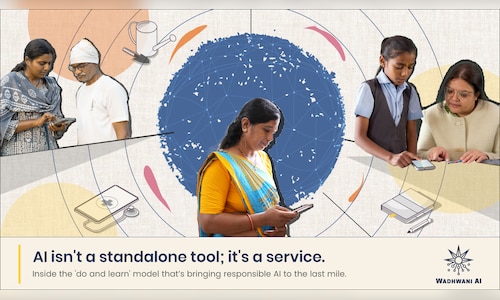
Designing with these constraints in mind results in a distinctive kind of robustness; systems that can adapt to noise, variability, and real-world decision-making. AI acts as an integrated component of a broader service ecosystem rather than being a standalone tool.
This is where India’s relevance extends to a global context. Many public systems in the Global South confront similar challenges at varying scales. AI solutions effective in India may be easily adaptable because they are designed to endure uncertainty and complexity.
The path forward
Recent years have underscored a fundamental truth: implementing AI in public systems is a long-term commitment, driven by ongoing cycles of learning and adaptation. Across the sectors of health, education, and agriculture, Wadhwani AI’s impact stems from sustained engagement.
As India’s digital public infrastructure continues to grow, the Institute will enhance its role by bolstering what is already effective, at a scale that is responsible, resilient, and firmly rooted in real-world applications.