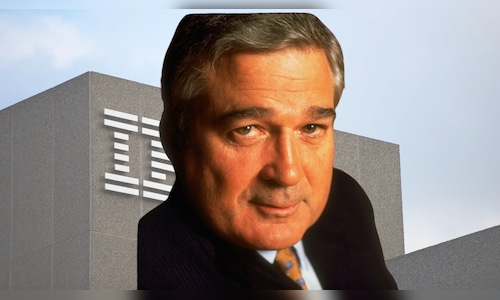
IBM’s chairman and CEO Arvind Krishna confirmed Gerstner’s passing in an email sent to employees on Sunday, though a cause of death was not disclosed.
Gerstner’s nine-year leadership as chairman and CEO of the company affectionately known as “Big Blue” is frequently studied in corporate leadership courses.
On April 1, 1993, he became the first outsider to lead IBM, which was at a crossroads of bankruptcy or disassembly after previously being the dominant force in personal computers and mainframes. He redirected the Armonk, New York-based company towards business services, moving away from hardware manufacturing and halting plans to divide the company into several semi-autonomous units—dubbed “Baby Blues”—to pursue higher profits.
Gerstner implemented cost reductions and divested unproductive assets, including real estate and IBM’s fine art collection. He let go of 35,000 out of 300,000 employees, ending a culture of lifetime job security rooted in the values of former CEO Thomas Watson Sr. from the early 20th century.
He championed company-wide collaboration, replacing the loyalty traditionally given to individual divisions, and linked compensation to overall corporate performance instead of individual achievements. To achieve performance targets, he prioritized regular accountability over annual performance reviews.
“People do what you inspect, not what you expect,” he stated.
A significant change he made was to eliminate IBM’s practice of selling bundled products that only functioned with other IBM offerings, ranging from PCs to operating systems to software. He discarded products he deemed unsuccessful, including OS/2, an operating system aimed to compete with Microsoft’s Windows that failed to gain traction with consumers.
“His leadership during that period reshaped the company,” Krishna remarked. “Not by looking backward, but by focusing relentlessly on what our clients would need next.”
Focus on Middleware
IBM shifted its emphasis to middleware—software designed for databases, systems management, and transaction management. The company positioned itself as an impartial integrator for clients’ networks and systems, offering support regardless of the hardware brand.
Gerstner recognized the potential of the internet and e-business early on, correctly predicting a diminished focus on personal computers in favor of servers, routers, and other advanced equipment leveraging IBM’s service expertise and catering to familiar buyers like chief technology officers.
Read Also: Ventive Hospitality shares worth over ₹8,700 crore to free up for trade as shareholder lock-in ends
As his tenure progressed, he also engaged in strategic acquisitions, such as the $2.2 billion investment in Lotus Development Corp., whose Notes product played a crucial role in enhancing collaboration for IBM’s clients on an enterprise level.
The transition from hardware to services resulted in a surge in services revenue from $7.4 billion in 1992 to $30 billion in 2001. During his nine years as CEO, IBM’s share price climbed from $13 to $80, adjusted for splits, while its market value increased from $29 billion to around $168 billion.
“If I had a vote, the most significant legacy of my tenure at IBM would be the truly integrated entity that has been created,” he reflected in his book Who Says Elephants Can’t Dance? Leading a Great Enterprise through Dramatic Change (2002). “It certainly was the most difficult and risky change I made.”
Louis Vincent Gerstner Jr. was born on March 1, 1941, in Mineola, New York, to Louis Gerstner Sr., a milk truck driver, and Marjorie Rutan, a secretary and college administrator. He was one of four brothers.
He graduated from Chaminade High School in Mineola, a competitive Catholic institution, and earned an engineering degree from Dartmouth College, followed by an MBA from Harvard University.
McKinsey Partner
Following Harvard, he joined McKinsey & Co. as a consultant, becoming a partner within four years and spending 12 years there before moving to American Express.
At Amex, he initially worked in the credit card division before taking charge of travel-related services. During his leadership, Amex bolstered its retail presence and developed premium cards that allowed customers to carry unpaid balances.
When he encountered obstacles in climbing up to the top management at Amex under CEO James D. Robinson III, Gerstner accepted the role at RJR Nabisco Inc., where he remained for four years prior to joining IBM. His main responsibility at RJR Nabisco was to reduce the $25 billion debt from the leveraged buyout that formed the tobacco and consumer products firm.
IBM’s board began searching for a new CEO after dismissing John Akers in January 1993, just as the company announced its largest annual loss. In selecting Gerstner, the board prioritized managerial experience over technical expertise. (Gerstner’s brother Richard had worked at IBM for 30 years and led the division responsible for personal computers.)
From Gerstner’s first day in April 1993 until the January 2002 announcement of his departure, IBM’s shares increased ninefold, compared to a 154% gain for the Standard & Poor’s 500 Index. Sam Palmisano succeeded him as CEO and later as chairman after Gerstner’s retirement in late 2002.
In 2003, Gerstner became the chairman of the Carlyle Group, a private-equity firm based in Washington. He oversaw the company’s expansion into Asia and Latin America and laid the groundwork for its public offering, which took place in 2012. He retired in 2008 while remaining a senior adviser.
Alongside his wife, Robin, he had two children. Their son, Louis III, tragically passed away in 2013 due to a choking accident in a restaurant.
Through Gerstner Philanthropies, the family has supported biomedical research, environmental initiatives, educational programs, and social services in New York City, Boston, and Florida’s Palm Beach County. They have also been long-time supporters of the Mayo Clinic.