According to a 2019 ruling allowing the government to claim a portion of the non-telecom revenue — referred to as adjusted gross revenue or AGR — since 1999, Vodafone Idea (currently under the Aditya Birla Group) has a debt of ₹79,000 crore owed to the exchequer.
The stock remains underwhelmed because the company may struggle to meet its financial obligations even with the proposed relief.
Gaurav Malhotra, executive director at Axis Capital, forecasts the effects of the proposed relief measures at ₹3 to ₹4 per share. “Currently, our target price is around ₹9. Thus, the ₹9 would increase to ₹12.5. It doesn’t significantly alter the situation,” he noted.
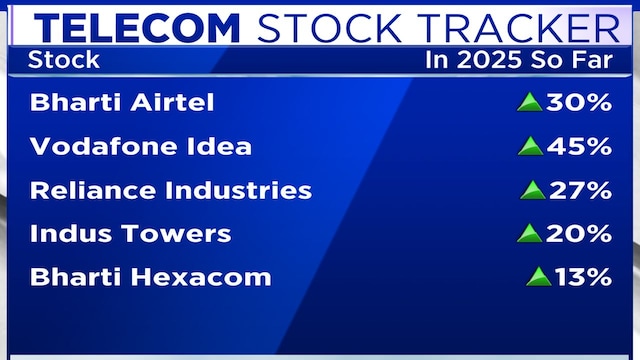
Vodafone Idea shares are now trading at ₹11.5 each. Even while incurring losses and losing subscribers, the shares have risen by nearly 45% this year. “It’s clear from the various interventions that the government is not aiming for a duopoly market,” Malhotra added.
Nonetheless, the government’s intentions haven’t stopped users from leaving Vodafone Idea, leading to nine consecutive years of losses and a total debt exceeding ₹2 lakh crore by September 2025.
Although the current proposal may postpone payments, it’s uncertain if the company can generate sufficient profits to address its substantial debt obligations.
“There are two primary outflow factors: the AGR and the spectrum expenses. We often overlook that there is a spectrum liability of nearly ₹20,000 crore,” said Gaurav Malhotra, executive director at Axis Capital, a Mumbai-based brokerage firm, during a conversation with CNBC-TV18 on December 15.
Vodafone Idea has a liability of ₹1.22 lakh crore to the government regarding the spectrum it has purchased, which will also be payable over six years as per the proposal currently under discussion.
Here’s a breakdown of Vodafone Idea’s spectrum liabilities over the next few years:
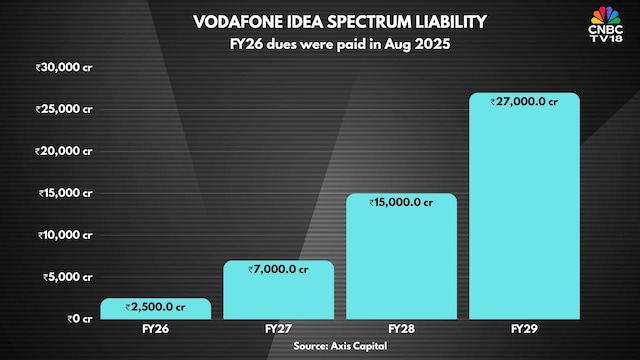
Vodafone Idea’s gross debt exceeded ₹2 lakh crore by September 2025, with spectrum liabilities constituting a significant portion of this debt. The company maintained ₹3,000 crore in cash reserves.
While the recent government relief, which owns 49% of Vodafone Idea, may offer some temporary respite, the company must significantly enhance its operations to meet its obligations beginning in 2029.
“If a payment of ₹15,000 crore is due three years from now solely for spectrum, then the ₹9,000 crore (cash) EBITDA will need to increase considerably,” Malhotra further elaborated.
EBITDA refers to earnings before interest, tax, depreciation, and amortization (EBITDA), and it assesses how profitable the core business of a company is.
Vodafone Idea’s FY25 EBITDA was reported to be over ₹18,000 crore, but this figure includes payments made to Indus Towers for leasing towers. The ₹9,000 crore mentioned by Malhotra and other analysts excludes rent as an operational cost.
The company needs to boost its average revenue per user (ARPU), necessitating a tariff increase—a challenge that even its larger competitors, such as Reliance Jio (over 500 million users) and Bharti Airtel (364 million users), have struggled to implement.
“A tariff increase is essential for improving the numbers. Although it has been delayed, I believe it’s just a matter of time; possibly between December and June,” Malhotra commented.
However, uniform tariff increases across companies won’t benefit Vodafone Idea. It requires a competitive advantage in both pricing and service quality, which would necessitate additional capital investments to enhance network coverage and promotions to attract users.
Catch all the stock market live updates here