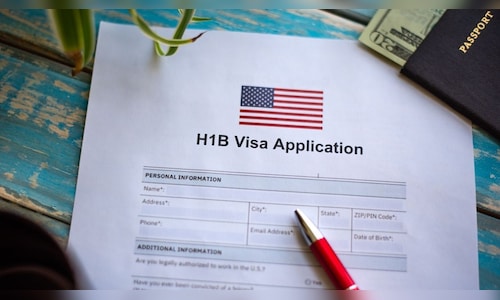
The US Department of Homeland Security has disclosed plans to replace the traditional lottery-based selection process for H-1B visas with a weighted model that favors higher-paid and higher-skilled workers, starting February 27 for the FY2027 cap registration season. While the overall annual cap of 65,000 visas plus an additional 20,000 for US advanced degree holders remains intact, this transition represents a major shift in how foreign tech talent will be integrated into the US workforce.
India IT’s low-cost deployment model under pressure
This new framework is likely to have a disproportionate impact on Indian IT service firms like Tata Consultancy Services, Infosys, Wipro, and HCL Tech, which have traditionally depended on sending a large number of mid-level engineers to client sites in the US.
Currently, nearly 70% of H-1B visas are granted to entry-level and qualified wage workers, while only 30% are awarded to high-paid specialists. US authorities assert that the weighted system is intended to prevent the misuse of the lottery process by employers hiring foreign workers at lower salaries while prioritizing talent that boosts American competitiveness.
Experts in the industry believe this may compel Indian IT companies to rethink their onsite staffing strategies, enhance localization efforts in the US, or offshore more work.
“US companies will still need talent,” remarked Naveen Chopra, Chairman of N & N Chopra Consultants. “If they can’t bring people into the country, they will simply relocate work to other countries where they already operate. That benefits other regions, not the US labor market.”
Visa stamping cancellations leave professionals stuck in India
As companies adjust to the new rules, individual professionals are experiencing significant distress.
A number of Indian H-1B holders who traveled to India for visa renewal and stamping have found their appointments unexpectedly canceled or rescheduled to mid-2026 or even 2027, frequently after arriving.
Sukanya Raman, Country Head of India at Davies & Associates LLC, noted that the issue has worsened in recent months.
“Individuals planned these trips months ahead, believing they would return to the US after stamping,” she said. “Now, appointments are being canceled upon arrival, leaving them stranded in India while their jobs and families are in the US.”
In many situations, only the principal applicant has traveled, with spouses and children staying abroad. There is ongoing uncertainty regarding whether these affected employees can continue to work remotely from India, which raises both legal and financial questions.
Markets react as costs and uncertainty rise
The uncertainty has already started to reflect in the markets. Shares of major Indian IT firms have come under pressure due to concerns over rising visa costs, stricter selection criteria, and disruptions to delivery models.
Compounding employer costs, a US judge recently upheld a $100,000 fee for processing specific H-1B applications, dismissing a challenge from the US Chamber of Commerce. This ruling reinforces the Trump administration’s tougher stance on employment-based immigration.
Also Read | ‘Minimal Impact on IT’: BNP Paribas analyst explains the H-1B Visa norms impact on Indian stocks
Rohit Bhardwaj, Country Head of India at Henley & Partners, indicated that the combined effect of policy tightening and increased costs is making the US significantly more selective.
“Professionals now need to carefully consider whether the US remains the best option,” Bhardwaj stated. “The standards are clearly rising in terms of skill and compensation.”
Skilled Indians look beyond the US
As access to the US narrows, alternative destinations are becoming more appealing.
Experts suggest that countries like Ireland, the UK, Singapore, and various parts of the European Union are emerging as viable options for Indian tech professionals, particularly where US multinationals already operate and offer competitive salaries.
“We are witnessing EU countries actively inviting highly skilled entrepreneurs and professionals to enhance their innovation ecosystems,” Bhardwaj commented, adding that global immigration is increasingly prioritizing quality over quantity.
For Indian tech workers, this shift may mean relocating rather than missing opportunities entirely. “This is a borderless world,” Chopra observed. “Talent will migrate to where it is welcomed.”
A strategic reset for talent and companies
While experts believe the long-term effects on Indian talent flows may be limited, the immediate disruption is tangible—both for companies adjusting their hiring approaches and professionals navigating uncertain visa pathways.
The clear indication from policymakers is that global mobility can no longer be taken for granted. For Indian IT firms and workers alike, enhanced skills, higher-value roles, and geographic flexibility may now be essential to remain competitive in an increasingly fragmented immigration landscape.
Also Read | H-1B Visa Rules Changes: Infosys, TCS, other IT stocks fall for the second day running
Watch accompanying video for entire discussion.