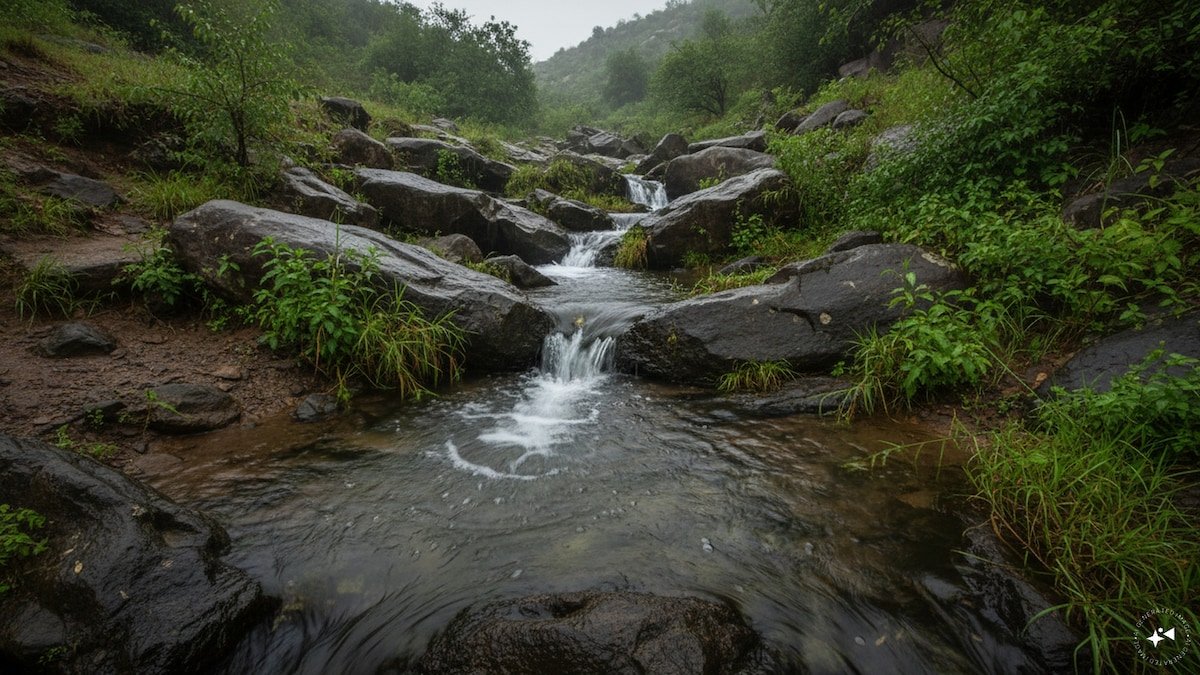
If you wish to witness this transient natural marvel, timing is key. These ephemeral waterfalls reach their zenith within a brief 12- to 48-hour window after a substantial rainstorm.
Why the Aravallis Cascade After Rain
This remarkable shift is rooted in geological factors. The Aravallis consist mainly of ancient quartzite, slate, and crystalline rock—materials that are impermeable and possess very low porosity, allowing minimal rainwater absorption.
When a heavy cloudburst delivers significant amounts of water in a short time, the thin topsoil quickly becomes saturated. Unable to permeate the hard rock, surface runoff cascades down natural inclines and narrow ravines, merging into swift streams (nullahs) that plunge over rocky cliffs like temporary waterfalls before gradually dissipating as the skies clear.
Top Trails & Cascades to Explore
1. Mangar Bani Valley (Faridabad-Gurugram Border | ~35 km from Central Delhi)
Accessible via the Gurgaon-Faridabad highway, Mangar Bani is an ancient, preserved sacred grove abundant with native Dhau trees. The valley’s slopes capture heavy rainfall, directing runoff into lively rocky streams.
2. Leopard Trail & Mandawar Ridge (Gurugram | ~45 km from Central Delhi)
Approximately an hour’s drive from the city center, this winding forest segment is a popular morning route for cyclists and road trippers. After significant rains, the surrounding green canopy highlights swift runoff streams that race alongside the road and cascade over stone ledges into natural depressions.
3. Sohna Ridge & Damdama Rim (Gurugram District | ~55 km from Central Delhi)
Accessed via the Sohna Elevated Corridor, the steep rocky faces along this ridge create some of the most striking elevation changes in the district, generating active seasonal feeder streams that rush toward the Damdama basin.
Know Before You Go: Safety & Eco-Advisory
Avoid Legacy Quarry Pits: The Aravalli region near Gurugram and Faridabad harbors old, abandoned stone-mining pits. Heavy rainfall can quickly fill these unmarked pits, forming deep water bodies with unstable, crumbling edges, making swimming or wading extremely hazardous.
Watch Your Footing: Monsoonal runoff can carry loose sediment and slippery algae over smooth quartzite rock. Wear sturdy footwear with good grip and steer clear of standing directly on wet ledges.
Respect Local Wildlife: The Aravallis act as a vital wildlife corridor, home to peacocks, hyenas, and leopards. Keep vehicle noise to a minimum, stick to designated paved paths, and remember to take all trash back with you.
Also Read: Delhi rainy day guide: Where to eat, what to see and how to spend a monsoon day in the capital