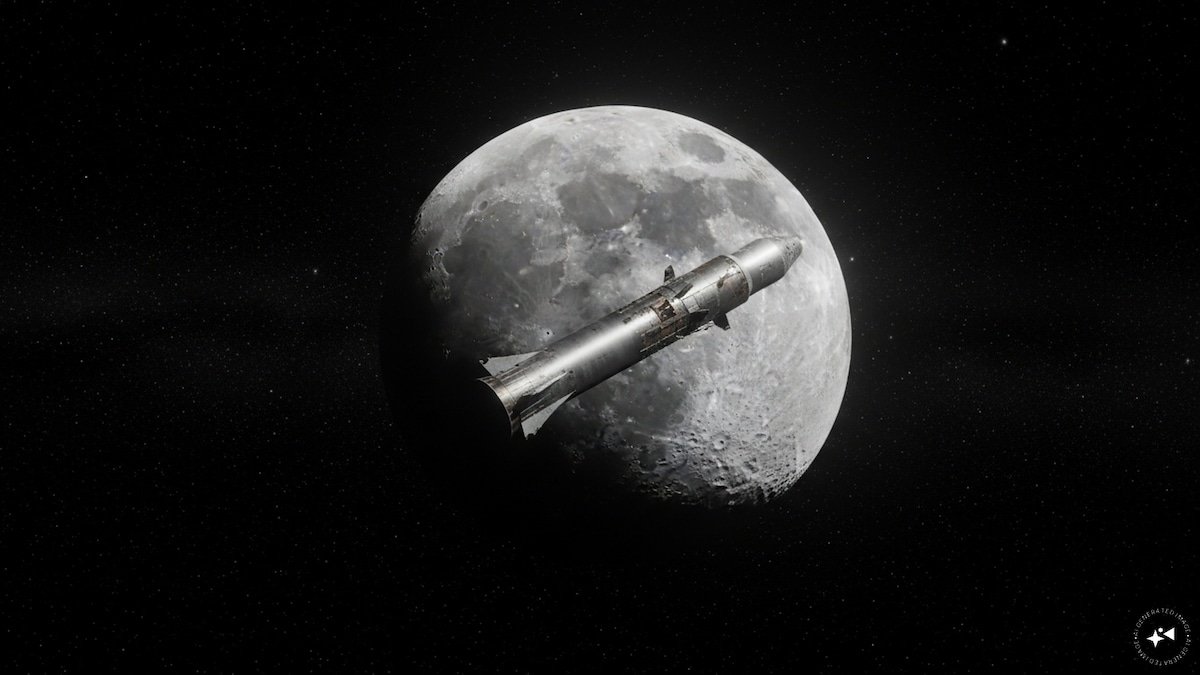
While the 5,400-mph (8,700-kph) impact has not been officially validated, space tracking experts stated that it was unavoidable that the leftover rocket piece struck the moon.
This incident adds to the growing concern about lunar debris, especially as the US and China compete to land astronauts on the moon. In 2022, a Chinese rocket accidentally hit the moon following a lunar mission, and it’s likely that numerous other rocket remnants have impacted the moon in previous decades without scientists being aware.
SpaceX’s Julianna Scheiman mentioned that the company is collaborating with NASA to prevent future collisions, emphasizing that this crash was unintentional. She explained that a mix of solar activity and gravity inadvertently set it on a trajectory toward the moon.
Retired astrophysicist Jonathan McDowell observed that data from Tuesday night indicated the dead 4-ton upper stage was on a direct path to the moon.
The expected crash site was a desolate area near Einstein Crater on the moon’s sunlit western edge — a location that is particularly hard to observe from Earth.
“I have no doubt” that the rocket “is now in tiny pieces scattered over the moon near Einstein Crater,” McDowell told The Associated Press.
“As a physicist, I understand that what goes up must come down,” he added.
Even if an asteroid had struck the rocket during its final approach, the debris would still have impacted the moon at the same location, McDowell explained. “It’s hard to imagine … that would alter its course significantly.” Stargazers were aware it would be challenging, if not impossible, to see the dust and rock plume from the resulting crater, much less the flash of light from the impact. Orbiting spacecraft had the best chance to observe anything — or at least to document the crater afterward.
Dutch scientist Marco Langbroek aimed his telescope at the moon during the expected event but saw nothing.
“We knew this would be a long shot,” Langbroek remarked.
Like McDowell, Langbroek expressed no doubt that the rocket met its end.
Visual verification, McDowell noted, will depend on NASA’s Lunar Reconnaissance Orbiter passing over the impact site and returning images of the crater. The agency anticipates this will occur next week.
The Falcon rocket’s upper stage — a large cylinder exceeding 40 feet (12 meters) long — launched two private lunar landers from Cape Canaveral on January 15, 2025. It became adrift after placing Firefly Aerospace’s Blue Ghost and ispace’s Resilience on a trajectory toward the moon. Resilience failed, while Blue Ghost successfully landed, becoming the first private spacecraft to do so.
The moon has emerged as a prime destination in space, with NASA planning a surge of robotic missions in the coming years to establish a sustainable lunar base. Elon Musk’s SpaceX and Jeff Bezos’ Blue Origin will supply the lunar landers for NASA’s Artemis program.
Musk’s Starship is progressing steadily with test flights from Texas, while Bezos’ Blue Moon lander has yet to launch. One or both landers are expected to participate in next year’s Artemis III, a docking test in Earth’s orbit. A lunar landing by astronauts — the first since NASA’s Apollo missions — could take place as early as 2028.
“Things are going to get a lot busier near the moon,” McDowell warned. “At that point, an impact like this on the lunar surface that kicks up vast amounts of dust spreading hundreds of miles will not be acceptable.”