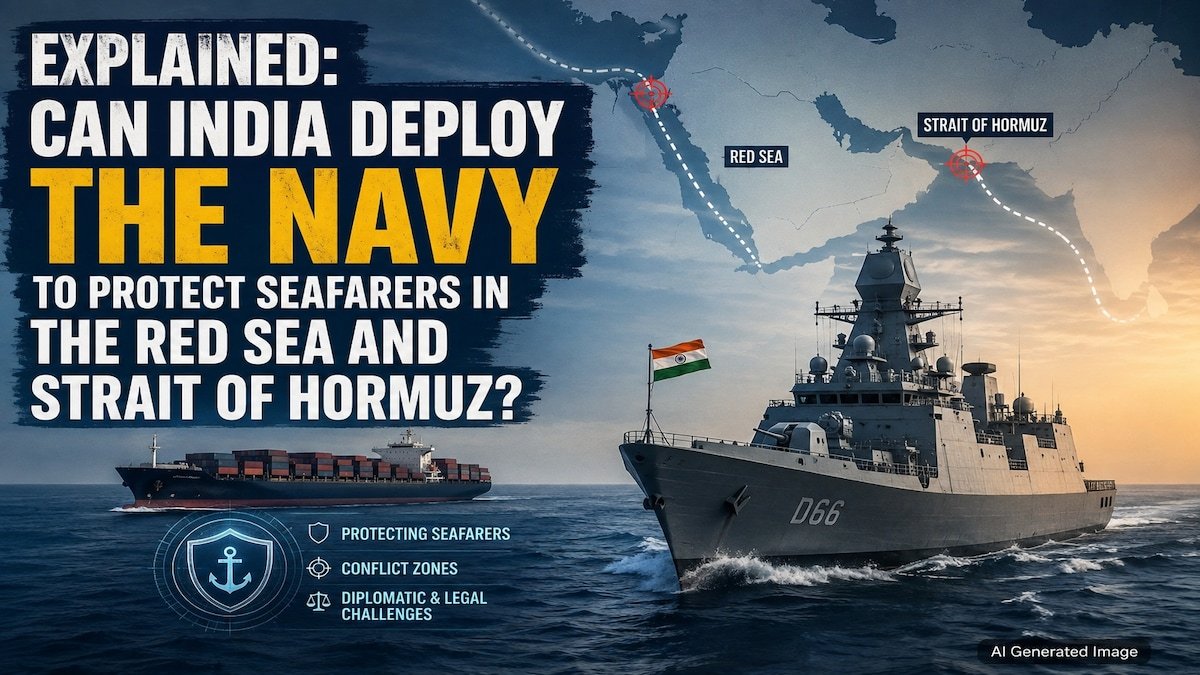
Following the attack on MSV Faize Noore Oliya off Yemen’s coast, the Forward Seamen’s Union of India (FSUI) has reiterated its call for the government to deploy the Indian Navy to safeguard Indian-flagged ships and seafarers navigating the Red Sea, the Strait of Hormuz, and the Black Sea.
But is it feasible for India to dispatch naval forces to escort commercial ships through active conflict zones? The simple answer is yes, but it’s complicated. While India has previously sent the Navy to protect merchant shipping from piracy, escorting vessels in conflict areas poses much greater military, diplomatic, and legal hurdles.
Here’s why.
Why is the seafarers’ union pushing for Navy deployment?
The catalyst for this demand was the recent attack on the Indian-flagged vessel, which sank after being struck by a projectile in near Yemeni waters. All 14 crew members, including 13 Indians, were successfully rescued and taken to the Port of Mokha for medical aid.
This incident has heightened fears that commercial shipping is increasingly at risk as conflicts in West Asia and Eastern Europe disrupt vital sea lanes.
The Red Sea and the Strait of Hormuz are some of the most strategically significant maritime corridors globally. A considerable portion of the world’s oil supplies and commercial cargo traverses these waters, making any disruption a concern not just for shipping firms but also for global energy markets and trade.
FSUI General Secretary Manoj Yadav mentioned that the union had reached out to Prime Minister Narendra Modi at the onset of the Iran-Israel conflict, requesting enhanced protection for Indian seafarers.
“We had already sent a similar letter at the start of the conflict… asking for support to deploy the Indian Navy in that area,” Yadav stated to CNBC-TV18.
He noted that merely issuing advisories is now insufficient.
“It’s time for India to take action to protect Indian seafarers… and secure our jobs instead of just issuing warnings that limit their ability to join ships.”
How many Indian seafarers are currently in conflict zones?
India ranks as one of the largest providers of merchant navy personnel, with Indian sailors employed by shipping companies worldwide.
According to Yadav, approximately 23,000 Indian seafarers were active in the Strait of Hormuz and the Persian Gulf when tensions escalated. He estimates that at least 15,000 are still present in the region.
He also pointed out that the union has recorded 14 fatalities since February, along with three missing seafarers linked to incidents in the Black Sea and the Strait of Hormuz. The count is continuously updated as ships navigate through conflict-prone waters.
Can Indian sailors simply decline hazardous voyages?
Legally, they can.
Under the Maritime Labour Convention, which India has ratified, seafarers have the right to refuse to sail into dangerous waters without jeopardizing their wages.
However, unions argue that exercising this right is often challenging in practice.
Over 80% of Indian seafarers work on foreign-flagged vessels owned by overseas entities. Refusal of an assignment could harm their job prospects or even lead to being blacklisted by shipping companies.
“Yes, they have that right,” Yadav commented, but added that many are hesitant as India mainly serves as a labor-supplying nation where workers fear losing future assignments.
He also noted that many crew members may be unaware of entering conflict zones until voyage plans are finalized by ship operators or charterers.
Why isn’t deploying the Indian Navy a simple solution?
Though the union’s plea seems reasonable, strategic affairs expert Anju Gupta explained that escorting commercial vessels through active conflict zones involves considerable military, diplomatic, and legal complexities.
She highlighted that even the United States, with its larger naval presence, has faced difficulties providing escorts for merchant ships transiting the Strait of Hormuz.
“If America cannot send its ships or escort vessels out of the Strait of Hormuz, can we expect India to manage that?” Gupta questioned.
She emphasized that most merchant vessels have continued their passage without dedicated naval escorts and have sometimes relied on protection from regional entities.
Unlike anti-piracy missions, escorting merchant vessels through active conflict zones may require operating close to the territorial waters and navies of multiple nations, presenting complex operational, diplomatic, and legal challenges.
How does this differ from anti-piracy missions?
India has previously engaged the Navy in anti-piracy operations such as Operation Sankalp and as part of global efforts in the Gulf of Aden.
However, Gupta noted that deployments related to conflicts are fundamentally distinct.
Anti-piracy missions typically target non-state actors and are often conducted under multinational security frameworks with broad diplomatic support. Escorting merchant vessels amid active regional conflict is considerably more intricate as naval forces may need to operate alongside multiple sovereign states and active military engagements, escalating both operational risks and the potential for conflict.
“It’s not as simple as deploying a navy to just operate in risky waters,” she added.
“That’s not how it works, especially for a nation like India that adheres to international laws and norms.”
What options are available to India?
India has decried the attack on the Indian-flagged vessel as “unprovoked” and has called for unhindered navigation through international waters. The Ministry of External Affairs confirmed that the Indian Embassy in Riyadh is cooperating with Yemeni authorities to ensure the safety of the rescued crew.
For the time being, diplomatic efforts, international collaboration, advisories, and vigilant monitoring of shipping routes are India’s primary strategies for protecting its seafarers and commercial interests.
The recent attack has, however, reignited discussions about the adequacy of these measures as maritime security risks extend across the Red Sea, the Strait of Hormuz, and the Black Sea.
While India has the capacity to deploy naval forces if deemed necessary, experts assert that routinely escorting merchant vessels through active conflict regions is neither a simple military decision nor operationally straightforward. Such actions would demand sustained naval resources, extensive diplomatic coordination, and careful risk assessment, highlighting why safeguarding Indian seafarers in some of the world’s most volatile waters remains an immensely complex challenge beyond merely dispatching warships.