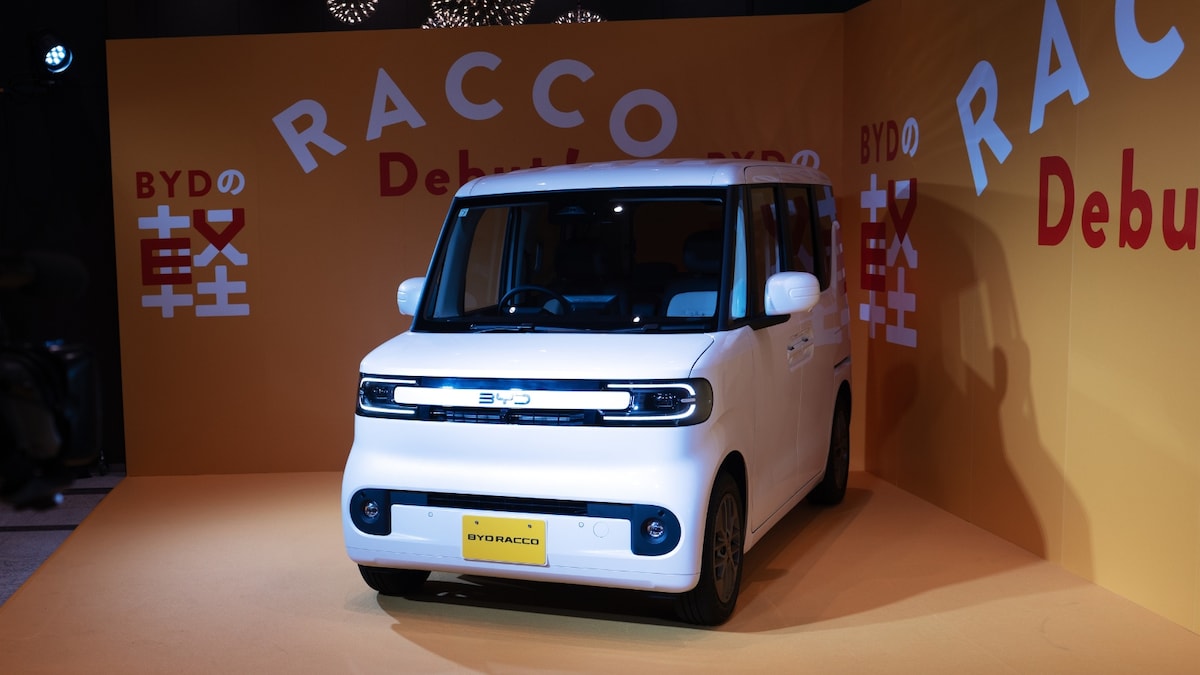
The entry-level Racco, inclusive of subsidies, will be priced below ¥2 million ($12,210) and provides a minimum range of 210 kilometers (130 miles), according to Atsuki Tofukuji, CEO of BYD Auto Japan. This positions it as a direct competitor to Nissan Motor Co.’s Sakura — the top-selling EV in Japan.
Affordable and ultra-compact “kei” cars represent nearly 40% of new vehicle sales in Japan. Typically available as micro vans or trucks, they cater to the unique demands of the island’s narrow streets and rural routes, with new gasoline models starting at approximately ¥1.2 million.
With the launch of a minicar, BYD steps into competition with Japan’s dominant automakers in their domestic market, a space that few foreign manufacturers have successfully penetrated. This kei car introduction signals BYD’s commitment to Japan, despite a lackluster performance since entering the market over three years ago.
Toyota group companies Suzuki Motor Corp. and Daihatsu Motor Co., along with Honda Motor Co., command around 80% of the minicar market, a pivotal entry-level segment, as cited by Bloomberg Intelligence.
“Automakers view minicars as a practical entry point, with shorter daily commute distances alleviating battery capacity and range issues,” noted BI analysts Tatsuo Yoshida and Marie-Christine Yoko Huss in a report last week.
The small-sized cars have gained a dedicated following among some enthusiasts in the United States. They have attracted even US President Donald Trump’s attention, who last year advocated for the production and sale of Asia’s “cute” compact vehicles in the US, despite safety concerns regarding their suitability on American roads.
Electric vehicles have experienced a lukewarm response among Japanese consumers, posing a challenge for the Racco as both a foreign brand and an all-electric option.
Nissan’s Sakura, which captured 22% of Japan’s total EV sales in 2025, starts at approximately ¥2.44 million and offers a maximum range of 180 kilometers on a full charge. Meanwhile, Honda’s electric mini car — the “N-One e:” — begins pricing at around ¥2.7 million.
Nevertheless, both model prices can drop significantly with substantial subsidies, depending on the purchase location. For instance, the subsidized price of a new Sakura in Tokyo can plummet below ¥1 million.
BYD’s Racco has a starting price of ¥2.15 million, with premium variants approaching ¥2.5 million. Tofukuji confirmed that all versions will qualify for ¥150,000 in EV subsidies.
Non-Japanese brands represent merely a small fraction of new car sales, despite the efforts from major global manufacturers like Stellantis NV and Hyundai Motor Co. European brands like BMW AG and Mercedes-Benz Group AG have seen more success in capturing a niche market for foreign luxury vehicles.
Nonetheless, BYD has consistently expanded its model offerings and developed a dealership network since initiating passenger vehicle sales in Japan over three years ago.
The automaker is on track to deliver 10,000 vehicles in Japan by the end of this month, according to BYD Japan President Liu Xueliang during a press conference in Tokyo. The company has also set up 77 sales points nationwide, including 56 authorized dealerships.
In January, the Chinese EV firm announced plans to introduce two hybrid models to its Japanese lineup to enhance sales. These vehicles — the Atto 2 and Seal 6 — will complete an eight-car lineup that BYD committed to launch in Japan.