He reassured the audience of journalists that he had omitted the harshest parts of his speech.
“That was going to be a doozy,” Trump remarked about the address he was set to deliver in April, which was postponed after a gunman disrupted the original event.
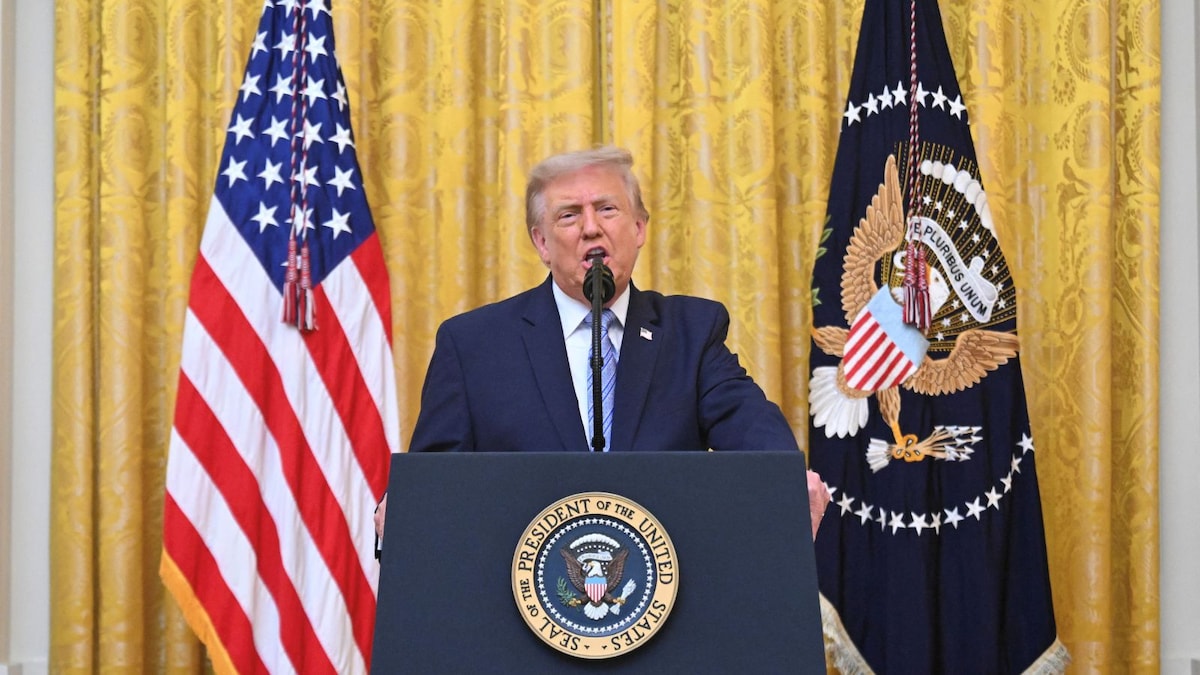
“Like I said three months ago, the show must go on,” Trump stated at the outset, applauding the decision to hold the dinner again. He mentioned “the attempted mass murder” that could have occurred that night in April but primarily shifted to humor — and barbs.
Trump’s comeback to the correspondents’ dinner — along with his indication that he would return next year — marked a significant moment in his contentious relationship with the media, which he has criticized, sued, and taken administrative measures against since the start of his second term early last year.
ALSO READ | Trump states he won’t proceed with nuclear deal unless Saudis join Abraham Accords
Among the attendees were journalists he had previously condemned and excluded from events.
His sometimes risqué remarks, which spanned just over an hour, targeted individuals he holds in disdain — including Jane Fonda, Bruce Springsteen, and “Barack Hussein Obama.” The crowd, initially responding with laughter, gradually fell silent as the jabs accumulated.
Among others, Trump poked fun at late-night hosts Jimmy Fallon and Jimmy Kimmel; Rep. Ilhan Omar, D-Minn.; California Gov. Gavin Newsom; former New Jersey Gov. Chris Christie; and even his own speechwriters, whose material he sometimes criticized mid-delivery. Some comments veered close to racism.
He also took pride in the ballroom at the Waldorf Astoria hotel, previously the Trump International Hotel. “It’s fantastic to be back at a place I know well, because I built it,” Trump remarked.
He briefly touched on the journalism awards given out earlier that evening, most of which honored stories that were critical of him and his administration. “Do I get a say in those awards?” he asked, grimacing.
He referenced the conflict with Iran and made several comments about the ballroom he is constructing at the White House. The occasion also served as a platform for joking about the possibility of a third term — which the US Constitution’s 22nd Amendment prohibits.
ALSO READ | Trump labels EU’s Google fine ‘illegal’, initiates Section 301 investigation
“Just like my presidency, the second time is always better,” the president jested. “And the third time will be even better.” He added: “I’m just kidding.” At the conclusion, he donned a red cap that read “Trump 2028” and announced he was running again.
Earlier, Trump entered the ballroom to polite applause and was acknowledged by outgoing White House Correspondents’ Association president Weijia Jiang of CBS News for his support. Following dinner, he sat through over an hour of award presentations.
One award recipient, Tyler Pager of the New York Times, was one of the journalists subpoenaed by Trump’s Justice Department over his reporting on Trump’s Air Force One jet gifted by Qatar.
Those subpoenas were revoked on Thursday in a New York courtroom — just one of the areas where the president, in his second term, has sought to influence media portrayal that displeases him.
The rescheduled dinner was held in a smaller venue this time, accommodating about 700 guests. Security measures were notably stringent. Attendees entered through a single entrance, undergoing two ID checks and passing a detection dog, armed officers, and security personnel. There was no red carpet or separate cocktail receptions before the dinner.
“Let’s try this again,” Jiang humorously welcomed the crowd. The White House press corps, she noted, “always has a follow-up.” Turning serious, she reflected on the trauma and chaos of the original dinner in April.
“Tonight our message is this: We are back,” she declared. “We will not be intimidated. We refuse to allow an act of violence to define us.” Early in his address, Trump signaled a decision to tone it down. Still, he couldn’t resist a few jabs. Like this one, aimed at the media-heavy audience:
“This is really the largest gathering of ‘Trump Derangement Syndrome’ individuals assembled at one time.” Awards were given for bravery during the April shooting.
In addition to the more subdued tone, there was another new element at Friday’s dinner: two more awards. One was given to Victor Gonzales, the Secret Service agent who was stationed at a security checkpoint in April and was struck in his protective vest.
Gonzales “put himself directly in harm’s way and confronted the armed suspect,” Jiang said. “He remained in the fight, and the assailant was halted.” A second award honored the staff of the Washington Hilton hotel, host of the first dinner, commended for their professionalism under pressure.
The dress code was a relaxed “black tie optional,” and the dinner featured grilled peach and burrata salad, lobster, and beef Wellington. The evening, as in April, included entertainment by mentalist Oz Pearlman — who this time was able to perform his act.
Jiang and her fellow board members made concerted efforts to bring about this WHCA dinner 2.0, determined not to let a violent act — or the memories of colleagues hiding under tables — overshadow the event. When announcing the rescheduling, she highlighted the dinner’s stated purpose: “A celebration of a free press and the indispensable role of journalism in our democracy for over a century.” Despite ongoing criticism of the event, it’s evident some felt it should not have been rescheduled at all.
Many believed it reflected poorly, showcasing journalists dressed in formal wear mingling with their sources or subjects of their reports.
ALSO READ | Trump administration imposes 10% tariff on India, lower than the proposed 12.5% levy
“It undermines public trust in the way the press operates, and it suggests a closeness with the people we cover,” stated Kelly McBride, an ethics expert at the Poynter Institute, a journalism think tank, during the deliberations.
The new dinner unfolded amidst escalating tensions between the media and a president who, in his second term, has sought to pressure media outlets he finds unfavorable in various ways. Those pressures have included sanctions against members of the White House press corps, regulatory actions via the Federal Communications Commission, and outright lawsuits. Tensions have intensified since April.
However, Trump concluded with a gesture of goodwill — to some extent. “I have immense respect for your profession,” he told the gathered journalists. He also boasted of his accomplishments, declaring: “When I’m out of the picture, you’re all going to be broke.” He wrapped up by saying of the evening: “I had no idea what to expect. It’s far worse than I originally anticipated.