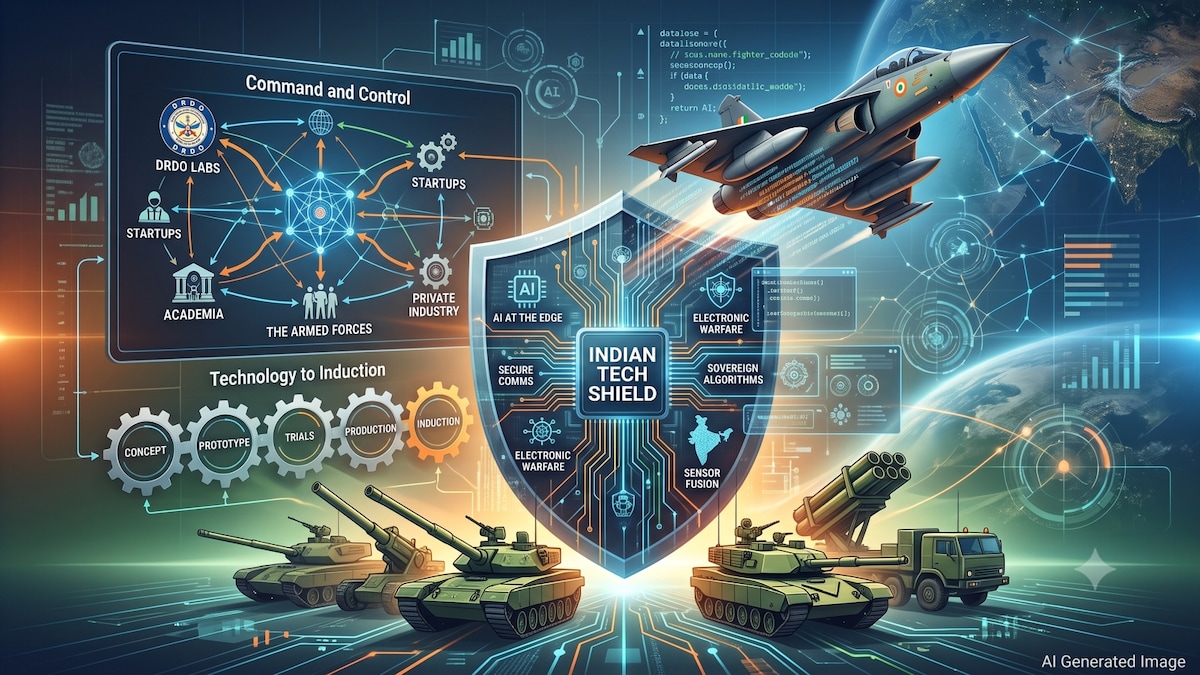
While these platforms continue to be significant, the dynamics of warfare are evolving.
Today’s military framework is increasingly characterized not only by the hardware itself but also by the sensors, software, data, artificial intelligence, communications, and electronic warfare capabilities that support it.
This raises a crucial question for India: as warfare transitions toward a software- and data-centric model, how can the nation develop military systems that it not only produces but also thoroughly comprehends and controls?
The response is beginning to transform India’s defense technology approach.
Chandrika Kaushik, Director General, PC&SI, DRDO, stated to CNBC-TV18 that technology is becoming intricately woven into contemporary defense systems, with AI progressively integrated into developing platforms and systems.
Why the battlefield is turning into a technology competition
A fighter jet or missile remains a tangible asset. However, its military effectiveness increasingly relies on elements beyond its physical form.
Sensors gather intelligence. Communication networks relay it. Software analyzes it. AI can assist in identifying patterns and potential threats. Command-and-control systems aid in decision-making. Electronic warfare capabilities can incapacitate an adversary’s communications or sensory operations.
The outcome is that military capability is becoming an amalgamation of hardware, software, data, and connectivity.
This is particularly vital in electronic warfare, where the capacity to detect, analyze, and dominate the electromagnetic spectrum can dictate what an adversary perceives, communicates, or executes.
“Whoever controls the spectrum controls the war,” Kaushik remarked, accentuating the escalating significance of electronic warfare.
This shift is evident in India’s Airborne Early Warning and Control system, Netra. While the aircraft platform itself relies on a foreign original equipment manufacturer, the mission systems, logic, and intelligence integrated within the platform have been created using indigenous technology.
This distinction is increasingly critical.
Defense sovereignty now encompasses not only the production of the physical platform but also the command of the technology that equips that platform with intelligence.
What does sovereign AI entail in defense?
Artificial intelligence is progressively employed to analyze vast quantities of data and support military systems. However, merely utilizing AI does not inherently signify that a country governs the technology behind it.
For defense purposes, the pivotal question is: who possesses control over the algorithms, the data used for their training, and the software framework on which they function?
Kaushik indicated that DRDO is striving to guarantee that the algorithms, training datasets, and software stacks developed for defense purposes are indigenous.
“If you control the software stack, you control the data on which you are training your algorithms,” she remarked.
This is critical because an AI system is shaped by its training data. If pivotal military AI systems rely on external datasets or foreign software that cannot be modified independently, the nation employing them may have constrained control over the evolution of those systems.
There are also consequences for cybersecurity, system upgrades, interoperability, and the ability to adapt technology to shifting battlefield scenarios.
That is why DRDO has established software development guidelines, verification and validation processes, along with a framework to assess AI stacks.
The overarching goal is to ensure that vital defense systems are not merely imported as ready-made products but are constructed on technologies that India can comprehend, adjust, and sustain.
Why AI is heading towards the battlefield
Another significant evolution in defense AI lies in the decentralization of intelligence, bringing it closer to the places where data is produced.
This concept is known as AI at the edge.
In traditional models, a sensor collects data and sends it to a centralized location for analysis. Conversely, an edge AI system can process data directly on a sensor, vehicle, aircraft, or other platform.
This capability is essential in military scenarios.
Battlefields may have constrained connectivity. Communication networks could face disruptions. Transmitting every piece of data back to a central command could also introduce delays.
Thus, local data processing can facilitate quicker responses and continuous operations even amidst unreliable connectivity.
For instance, an AI-equipped sensor could discern patterns or categorize objects near where the data originates, instead of waiting for information to be transmitted for analysis elsewhere.
Kaushik stated that DRDO is actively pursuing the integration of AI across defense systems and embedding AI capabilities directly onto platforms and sensors to ensure they function effectively in field conditions.
The significance of this transition is that AI is moving from a background analytical tool to an integral component of operational equipment used on the battlefield.
The challenging question: who decides to fire?
This issue is particularly pressing when autonomous systems can exert lethal force.
A global discourse is ongoing regarding lethal autonomous weapon systems, centering around the notion of human oversight.
A human can be “in the loop,” where a person finalizes decisions before systems act.
Or, a human can be “on the loop,” where autonomous systems function independently while a person observes and can potentially intervene.
This distinction is crucial since the rapid tempo of modern warfare may soon surpass the ability of humans to manually analyze every detail of information.
Simultaneously, assigning executable decisions involving lethal force to autonomous systems raises legal, ethical, and operational dilemmas.
Kaushik noted India’s stance is that safeguards and parameters are essential for autonomous systems with lethal capabilities.
“We must have a human in the loop for any lethal action command,” she emphasized.
This creates a challenging balance.
Military systems may need to operate at machine speed, yet the ultimate accountability for deploying lethal force should ideally lie with a human operator.
The complexity may increase if various countries develop and implement autonomous systems based on differing standards of human control.
Why India requires multiple defense research organizations
The transition towards AI, software, and autonomous systems is also reshaping the way defense technology needs development.
India’s traditional defense research framework was primarily oriented around government research bodies creating technologies that were then manufactured by public-sector firms.
However, contemporary technologies are advancing too swiftly and are overly intricate for a single organization or limited group of institutions to independently cultivate every capability.
As a result, the emerging model is becoming more decentralized.
This involves:
- DRDO laboratories
- Startups
- Private-sector businesses
- Public-sector entities
- Academic institutions
- The armed forces
Initiatives such as the Technology Development Fund, the iDEX program, and other indigenous development projects are part of this broader innovation framework.
The reasoning is quite straightforward. Startups might be able to swiftly create new software or AI capabilities. Established companies may possess the production scale necessary for manufacturing. DRDO may hold specialized defense technology expertise. The armed forces contribute insights into operational requirements.
The challenge lies in effectively linking these capabilities.
Why creating a prototype is insufficient
One of the most significant hurdles in defense technology is the gap between prototype development and scaling to production.
A prototype showcases that a technology can function but does not automatically prove that the system can be produced reliably, maintained through its operational lifespan, or manufactured in volumes sufficient for the armed forces.
The transition consists of several phases:
Technology development → prototype → user trials → modifications → productionization → scalable manufacturing → induction
New challenges may arise at each phase.
A design may need adjustments post-trials. Components might require redesign for mass production. Manufacturing capacity may still be underdeveloped. Quality assurance processes might need establishment. A production partner could have been uninvolved during the original development.
This can create notable delays between technology being crafted in a laboratory and its eventual deployment by armed forces.
DRDO has sought to remedy this by integrating development more closely with the acquisition and production processes.
For major mission-mode initiatives, clarity on the expected production quantities is established early on. An industry development-cum-production partner can then collaborate with the DRDO laboratory from the outset.
This allows the industry partner to engage in concurrent engineering, rather than entering the process only after prototype completion.
The aim is to ensure that the developed system is not just technically sound but also designed for large-scale production.
Establishing production facilities and integration capabilities earlier can also aid in reducing the time between development, trials, and induction.
The broader lesson is that defense innovation isn’t complete once a laboratory produces a working prototype. The technology must navigate the considerably more challenging transition from proof of concept to reliable military capability.
What this entails for India’s defense strategy
The evolution of warfare signifies more than the simple incorporation of AI into existing fighter jets, tanks, or missiles.
It represents a significant shift in the definition of military capability.
A contemporary defense system increasingly melds:
- A physical platform
- Sensors
- Communications
- Software
- Data
- AI models
- Electronic warfare
- Cyber capabilities
- Command-and-control systems
The entity that masters these components commands greater control over its military capabilities.
For India, the strategic challenge is twofold.
Firstly, it must cultivate critical technologies indigenously, particularly in domains like AI, software, sensors, communications, and electronic warfare.
Secondly, it requires an ecosystem that can rapidly transition these technologies from research and development to dependable, large-scale production.
This does not imply that traditional military platforms are losing relevance. Fighter jets, tanks, missiles, and warships will continue to play vital roles in military operations.
However, their success will increasingly hinge on the technology supporting them.
The future of warfare will likely not be a dichotomy between hardware and software. Rather, it will focus on the effectiveness of their integration.
For India, the strategic aim is becoming clearer: build not just the platforms that engage in conflict, but also the indigenous technology framework that enhances those platforms’ intelligence, connectivity, and autonomous capabilities.
This transition—from constructing military hardware to commanding the technological ecosystem that underpins it—could become one of the most pivotal transformations in India’s defense strategy for the future of warfare.