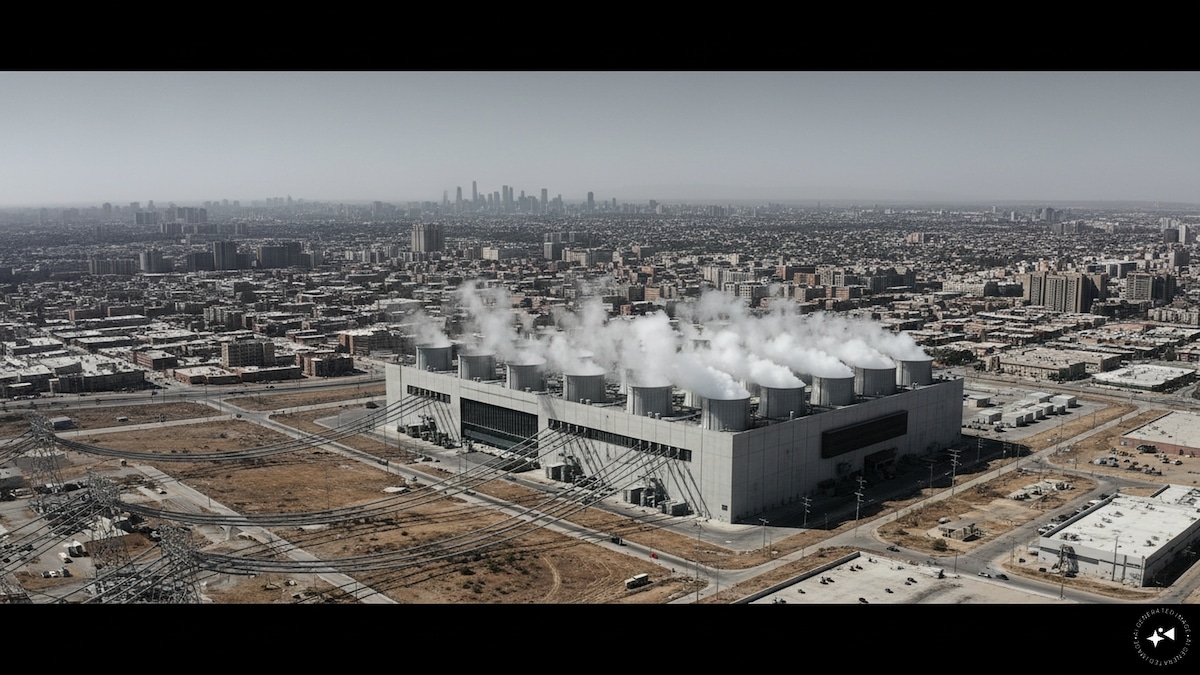
He suggested that future gigawatt-scale AI data centres should be situated close to renewable energy sources rather than in densely populated cities, where existing demand is high and expanding transmission infrastructure poses additional challenges.
Using Mumbai as an example, Jain noted that nearly 5,000 megawatts (MW) worth of memorandums of understanding (MoUs) have already been established for data centres in and around the city, which experiences a peak power demand of about 4,700 MW. He warned that adding such significant power needs alongside increasing household electricity use could severely strain the city’s grid.
Mumbai is not unique in this regard. Other cities like Hyderabad, Delhi-NCR, Bengaluru, and Chennai are also becoming key data centre hubs and are under similar pressures related to electricity and water infrastructure, as highlighted by industry reports.
A document from the Institute for Energy Economics and Financial Analysis (IEEFA) indicates that a typical large data centre consumes as much electricity as an aluminium smelting facility, roughly equivalent to the energy needs of 100,000 homes. As more data centres gather in the same vicinity, the strain on local power grids is likely to escalate.
Narendra Sen, founder of AI cloud service provider NeevCloud, has raised similar alarms, cautioning that the expansion of AI-driven data centres in India could exert further stress on the country’s power infrastructure.
“Data centres are highly energy-intensive and use more electricity than many of our cities. With the rise of AI, the volume of queries will lead to a projected increase of 20 to 30 times in power consumption in the future,” Sen stated in comments reported by the Malaysian newspaper The Star.
Jain also highlighted another obstacle. Constructing new high-voltage transmission lines is challenging since they require straight, unobstructed routes and often encounter land acquisition and right-of-way hurdles.
Indian power planners have already begun integrating these shifts into long-term capacity strategies. According to the Central Electricity Authority’s (CEA) Long-Term National Resource Adequacy Plan for 2026-27 to 2035-36, burgeoning electricity loads such as data centres, green hydrogen production, and other emerging industries are now explicitly included in the national demand forecasts.
The CEA anticipates India’s peak electricity demand will increase from 289 GW in 2026-27 to 459 GW by 2035-36, while the annual electricity requirement is projected to rise from 1,929 billion units to 3,365 billion units during the same timeframe. The report identifies data centres as a primary factor driving future electricity demand.
To accommodate this expansion, the CEA mandates states and power distribution companies to submit rolling 10-year demand forecasts annually to enable proactive planning of generation, storage, and transmission capacities.
Additionally, it forecasts that non-fossil fuel sources will constitute around 70% of India’s installed power capacity by 2035-36, with solar capacity expected to reach approximately 509 GW.
Also read: Why power, not water, could slow India’s AI data centre boom