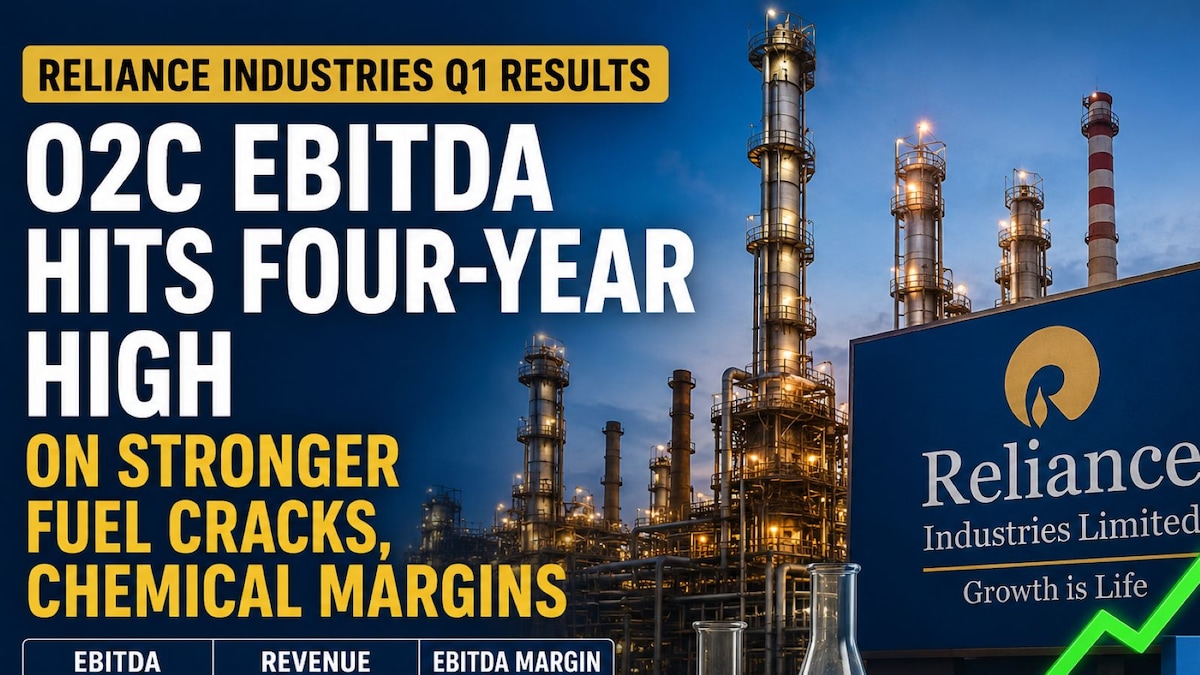
The O2C division recorded revenues of ₹2.02 lakh crore, an increase from ₹1.85 lakh crore in the March quarter and ₹1.55 lakh crore a year prior.
EBITDA climbed to ₹17,010 crore, up from ₹14,520 crore in the previous quarter and ₹14,511 crore in the same period last year, representing the highest quarterly EBITDA for the segment in four years. The EBITDA margin improved sequentially to 8.4%, up from 7.9%.
Reliance credited this robust performance to a substantial recovery in refining economics. Transportation fuel cracks experienced a surge of 2.5 to 4.5 times, with middle distillate cracks reaching record quarterly averages.
Additionally, the company benefited from downstream chemical deltas hitting three-to-four-year highs, driven by favorable product spreads and the ongoing cost advantage of ethane cracking over naphtha.
For key petrochemical products, the spreads for polyethylene (PE) increased by 79.1% sequentially and 45.7% year-on-year, while polypropylene (PP) deltas grew by 66.4% compared to the previous quarter.
Chairman and Managing Director Mukesh Ambani noted that the O2C sector had a solid quarter, underpinned by all-time high middle distillate cracks and improved downstream petrochemical deltas. “The beginning of FY27 gives me reasons to be optimistic about the upcoming year,” he remarked, noting that Reliance will advance with the phased launch of its New Energy projects and aim to unlock value through the anticipated Jio IPO.
This robust operational performance occurred despite facing several challenges. Earnings were impacted by the Special Additional Excise Duty (SAED) on petrol, diesel, and aviation turbine fuel, ongoing under-recoveries in domestic fuel retail, and reduced production due to planned maintenance.
Production available for sale was recorded at 15.6 million metric tonnes, down 9.8% year-on-year, mainly due to the planned shutdown of the crude distillation unit (CDU) and coker unit, along with increased LPG diversion.
Reliance also emphasized the ongoing expansion of its fuel retail business. The Jio-bp network expanded to 2,221 fuel outlets, with petrol sales increasing by 16.8% year-on-year, although diesel volumes fell by 1.9% during the quarter.
The company reported that the O2C sector, alongside its Digital Services and Retail segments, achieved double-digit revenue growth, reflecting strong momentum across its primary businesses during the quarter.
Oil & Gas: Stable earnings
Reliance Industries’ Oil & Gas segment reported an EBITDA of ₹4,973 crore during the June quarter, remaining relatively stable year-on-year, despite a narrowing of the EBITDA margin by 290 basis points. This resilient performance was supported by a higher contribution from KG-D6 oil and condensate production, along with increased coal bed methane (CBM) output and improved CBM price realizations.
However, the segment continued to encounter challenges from the natural decline in KG-D6 gas production, lower gas price realizations, and increased government levies. KG-D6 gas production decreased by 6.4% year-on-year, while the average gas price realization dropped by 10.8%. In contrast, CBM production increased by 7.4%, with price realization rising by 21.2%.