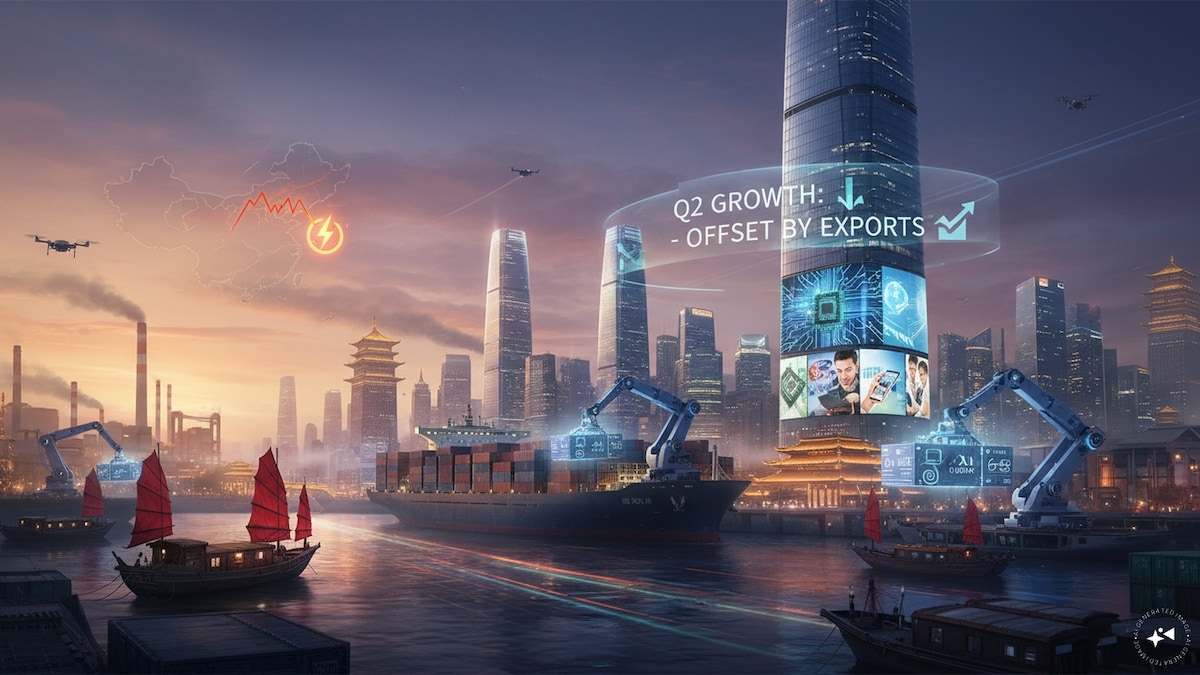
The world’s second-largest economy is becoming increasingly dependent on foreign trade for growth, as an ongoing slump in the property sector and lackluster consumer demand continue to be pressing issues.
Also Read: China’s consumer spending contracts further exposing economy to sluggishness
The US-Israeli conflict regarding Iran poses a threat to growth by disrupting shipping routes through the Strait of Hormuz, through which a significant share of global oil and natural gas is transported, raising concerns of a downturn that could diminish demand for Chinese exports.
However, data scheduled for release on Wednesday is expected to indicate that the country’s economy grew by 4.5% year-on-year from April to July, according to the median forecast from an AFP survey of experts.
This would mark a notable slowdown from the 5% growth seen in the previous quarter, yet still align with the government’s annual target of 4.5-5.0%
Dan Wang, a director at Eurasia Group’s China team and one of 11 analysts surveyed by AFP, noted that the economy has proven resilient against the energy and supply chain disruptions caused by the Iran conflict.
Also Read: China’s economy slows sharply as investment resumes declines
Nonetheless, he remarked that “declining global demand has a distinct negative impact on lower-end consumer goods and smaller exporters.”
In contrast, high-tech sectors have thrived, particularly those related to artificial intelligence and renewable energy, which have exhibited “stellar performance,” Wang noted.
AI boom
China managed to navigate a challenging trade war initiated by former US President Donald Trump last year, emerging with an astonishing $1.2 trillion trade surplus in 2025, the highest recorded.
Exports surged in the first half of this year, largely driven by demand for AI-related technology and automobiles, with overseas shipments rising 19.4% year-on-year in May.
In the second quarter, “external demand continued to outperform amid tariffs and geopolitical uncertainty,” Sheana Yue, a senior economist at Oxford Economics, told AFP.
She explained that this reflects “China’s improving competitiveness, ongoing gains in global market share, and its capacity for rapid scaling in higher-value manufacturing sectors.”
However, soaring exports are compensating for sluggish domestic demand and a muted business and household sentiment that “seems to have been further impacted by uncertainties from the Iran conflict,” Yue remarked.
Despite the government deploying billions of yuan in special bonds since 2024 to support consumer goods trade programmes and subsidies, retail sales fell for the first time in three years in May, and fixed-asset investment has declined as well, according to official data.
The debt crisis in China’s vast property sector, which began in 2020 and has unsettled consumers, continues to weigh heavily on the economy.
Once regarded as a vital source of wealth, home prices nationwide have plateaued, discouraging potential buyers from making investments.
“With no indication that the real estate crisis is concluding, a rebound in consumption seems unlikely,” stated Rabobank’s Teeuwe Mevissen.
Trade frictions
Analysts predict that new measures will be necessary to bolster growth in the latter half of the year, especially if the surge in AI exports wanes.
While policymakers concentrated on debt resolution and reform in the second quarter, there is likely to be a shift toward “re-prioritizing growth, with potential strategies to enhance investment and support services and employment,” according to Guo Shan at Hutong Research.
Also Read: China poised to be top tourism economy as foreigners skip US
Ongoing trade tensions with the United States and the European Union—China’s second-largest trading partner—could jeopardize Beijing’s exports and necessitate new efforts for economic rebalancing.
A US trade truce established last year is set to expire in November, while the EU is contemplating measures to shield domestic industries from what it views as unfair competition from China.
Amid subdued domestic demand, Chinese manufacturers, including electric vehicle producers, are looking abroad to enhance profits outside of the highly competitive local market.
“Ultimately, China’s capacity for sustained growth will hinge on a meaningful recovery in household consumption and a revival of private-sector confidence,” said Sarah Tan of Moody’s Analytics.