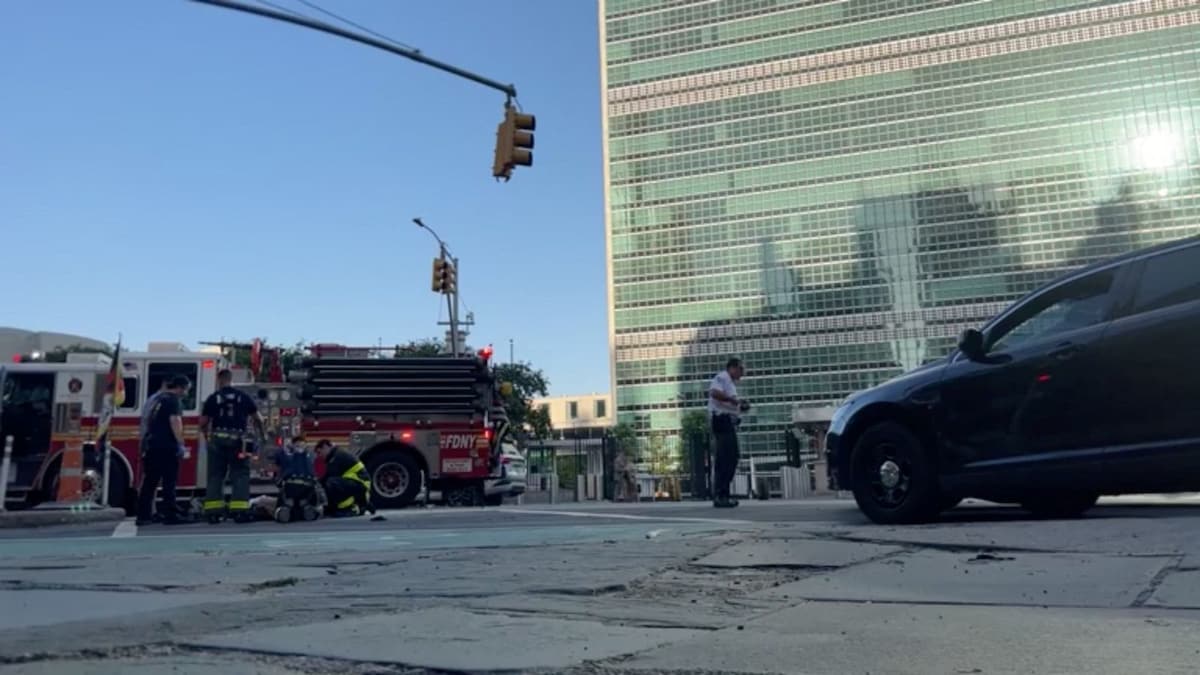
The individual, identified as Tibetan, was declared dead at Bellevue Hospital. The New York Police Department (NYPD) reported being alerted to the incident at approximately 6:30 pm ET, and investigations are underway.
“Today, if I engage in urgent activism, it is not due to a lack of food, clothing, or from despair. I do it for the Tibetan nation,” he stated in a video shared just hours before his self-immolation.
“Since I am acting for the Tibetan cause, all necessary actions for the Tibetan nation must continue,” he remarked in a video posted shortly before his self-immolation.
“There is no need for mourning. If mourning is required, then my hope and appeal should persist (folds hands). Please listen to my appeal,” he said with his hands folded.
The man placed a Tibetan flag on the sidewalk before igniting himself and collapsing to the ground within moments.
He had shared a video on Instagram about an hour prior to the incident, stating that Tibetans are being deprived of fundamental rights, including freedom of speech, religion, and the ability to display images of the Dalai Lama.
“Today, human rights as basic as freedom of speech and religion, or even keeping a picture of the Dalai Lama, are absent,” he expressed.
Self-immolation has emerged as one of the most prominent forms of protest among Tibetans opposing Chinese control.
According to the Central Tibetan Administration (CTA), a minimum of 159 Tibetans have self-immolated in Tibet since 2009. The International Campaign for Tibet reports that over 150 such incidents were documented between 2009 and 2022, with a few occurring among Tibetans in exile.
His act of protest followed the enactment of China’s new “ethnic unity” law.
While the man did not specifically link his self-immolation to this legislation, the law has spurred protests among Tibetans, Uyghurs, and Chinese dissidents across various cities globally, with critics arguing that it may further threaten the languages and cultures of ethnic minority groups.
The US and the European Union have also voiced concerns regarding this legislation.
China maintains that the law aims to foster a shared national identity among the country’s 55 officially recognized ethnic minority groups.
Local media reports indicate that the deceased worked as an Uber driver in New York and was an engaged member of the city’s Tibetan community.
China has ruled Tibet since its takeover of the region in 1950, which Beijing refers to as a “peaceful liberation.” However, human rights organizations and Tibetan exile groups have long accused Beijing of suppressing religious, cultural, and political freedoms in Tibetan areas, a claim that China disputes.
Also Read: China’s new ‘ethnic unity’ law has Tibetans, Uyghurs protesting worldwide
‘There is no need for mourning’: His final message
In his last message, he accused China of enacting policies aimed at dismantling Tibetan identity and urged Tibetans in exile to do more for those residing inside Tibet.
He expressed gratitude to Tibetans within the region for their efforts to maintain their language, script, religion, and culture, but insisted that those in exile must “work harder” and serve as voices for Tibetans who cannot freely advocate for themselves.
“We should identify as Tibetans. I am a Tibetan,” he asserted, raising his fist as he called for unity across Tibet’s diverse regions and religious sects.
Lobga also urged Tibetans not to cancel celebrations for the Dalai Lama’s 91st birthday due to his passing. He emphasized that cultural performances and festivities should persist, especially for the younger generation.
“There is no need for mourning,” he affirmed. “If mourning is required, then my hope and appeal should endure.”
He concluded his message by urging Tibetans to continue their struggle and proclaiming, “Bhod Rangzen Gyalo” — victory to Tibetan independence — and “Bhod Gyallo” — victory to Tibet.