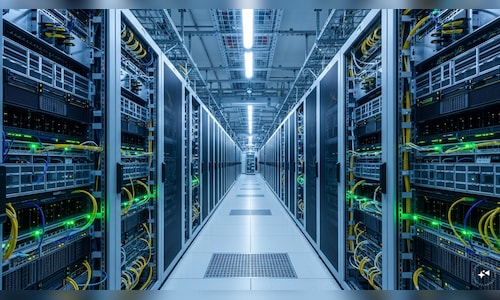
This upcoming supply, fueled by the rapid adoption of artificial intelligence, the growth of cloud computing, and data localization needs, exceeds more than five times the nation’s existing data centre capacity of 1.6 GW.
According to Knight Frank India, the country currently has 0.32 GW of data centre capacity under construction, while another 2.92 GW has progressed to the committed stage. An extra 5.41 GW is in the initial development phases, highlighting the extensive supply planned across key hubs. “The notable proportion of early-stage developments—almost two-thirds of the total pipeline—reflects substantial confidence in India’s long-term digital economy potential,” stated Knight Frank India.
Mumbai remains the leader in this arena with the largest pipeline of 3.75 GW, including 0.17 GW under construction, 1.54 GW in committed projects, and 2.21 GW in early-stage development. The city’s edge lies in its designation as India’s financial capital, extensive fibre connectivity, strong power infrastructure, and a concentration of international subsea cable landings, making it the preferred site for large-scale cloud and AI implementations.
Hyderabad has positioned itself as the second-largest future market with a 1.93 GW pipeline, bolstered by proactive governmental policies, lower operational costs, and increased investments from global tech firms. Chennai’s pipeline stands at 1.36 GW, supported by its importance as India’s primary entry point for Southeast Asian digital traffic, strong subsea cable links, and competitive energy tariffs.
Regional specialization is emerging as a significant trend, according to Knight Frank India. Viral Desai, international partner, senior executive director, Occupier Strategy & Solutions, Industrial & Logistics, Capital Markets & Retail at Knight Frank India, mentioned, “India’s data centre growth narrative is becoming increasingly focused on regional specialization. While Mumbai continues to lead hyperscale deployments due to its connectivity advantages, Hyderabad is becoming a favored hub for AI infrastructure, and Chennai is enhancing its role as a strategic entry point for international data traffic from the east. Simultaneously, Vizag has quickly become one of India’s most dynamic greenfield data centre markets, attracting gigawatt-scale development proposals supported by government backing, available land parcels, and planned subsea cable connectivity.”
NCR, Pune, and Bengaluru are also expanding their capacities, with pipeline figures of 0.54 GW, 0.43 GW, and 0.18 GW respectively. Knight Frank India anticipates that India’s data centre ecosystem will remain one of the fastest-growing globally in the coming decade as global technology companies invest in next-generation computing infrastructure.