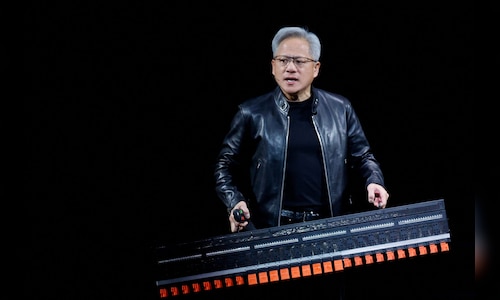
Huang is optimistic about AI’s ability to swiftly reshape society, promoting faster economic growth and groundbreaking scientific developments. However, as the leader of a computer chip company currently focused on AI systems, he acknowledges a growing public apprehension regarding the potential risks associated with the technology. He feels compelled to address concerns raised by critics about job displacement and existential threats.
“We need to establish new social norms,” Huang remarked during the interview. “I encourage everyone to engage with AI.”
Huang’s remarks came at a time when AI has become a contentious political issue, with rising opposition to additional data centre construction and fears that rapid adoption could lead to layoffs for employees lacking a safety net. These concerns have jeopardized public support for the technology amid a competitive landscape with China, which Huang believes the US can navigate successfully by embracing global AI competition.
His close ties to President Donald Trump have drawn criticism from Democrats, even as he stressed that the computational power brought by AI is essential for fulfilling long-promised factory job creation, despite limited past success. This perspective comes from a 63-year-old who has closely monitored technological progress and described himself as “boring” due to his life mainly revolving around work and family.
In the interview, Huang shared some personal insights, mentioning that his favorite movie is “Kingdom of Heaven,” the 2005 epic centered on the 12th-century Crusader Kingdom of Jerusalem. He also noted that he’s watched “Project Hail Mary” three or four times and plans to watch it again over the weekend.
Huang highlighted that AI’s capacity to design websites, analyze complex documents, aid in advanced research, or even plan kitchen remodels has effectively bridged the technological divide in America. People can now perform advanced tasks on computers without needing programming or software skills, he added.
He argued for some level of government regulation and safety standards for AI, emphasizing that national security must also be a priority for a technology that has driven stock market gains and the US economic growth in recent years.
Huang expressed confidence that society will adapt to AI similarly to how it adjusted to automobiles. He noted that cars were once feared for endangering children, but changes in societal norms, such as sidewalks and crosswalks, transformed that dynamic.
Huang questions the efficacy of government ownership of AI companies
Nvidia’s market capitalization has surged to about $5 trillion, making it the world’s most valuable company. AI modeling firms like OpenAI and Anthropic are also projected to reach or exceed a $1 trillion valuation once publicly listed.
This remarkable wealth surge concentrated in AI companies has raised concerns over economic inequality. Trump has attempted to alleviate those worries by suggesting that the US government could acquire shares in AI firms to ensure broader public benefit from any financial windfalls. This idea has also received backing from figures such as Senator Bernie Sanders and OpenAI CEO Sam Altman.
However, Huang expressed skepticism about the notion, believing that the country will already gain from advancements in AI.
“I’m not exactly sure what they are trying to achieve,” he said regarding government ownership. “I haven’t discussed this with them. It’s important to remember that these are American companies. Their successes benefit stock prices that many Americans invest in. They generate taxes that support a wide array of Americans. They also create numerous jobs.”
He pointed out that AI companies could enhance profitability for sectors such as energy, construction, and hardware technology.
“Americans already have a stake in American companies naturally, in many different ways,” Huang clarified.
Huang insists national security must take precedence in AI
Recently, the Trump administration shifted from a more lenient stance on AI regulation to implementing stricter controls.
It imposed export restrictions on the latest models from the AI company Anthropic, prompting the company to suspend public access to those models due to security concerns. Trump, a Republican, also issued an order mandating voluntary screenings by the government for new AI models prior to their release.
Huang acknowledged that the government was right to focus on national security but stressed the need for clear guidelines.
“National security should always be the primary concern for all technologies,” Huang stated. “However, you must be very specific about the risks you’re worried about before establishing policies for export controls.”
During the Biden administration, Nvidia resisted export limitations intended to restrict its chip sales to China, disputing the administration’s assertion that a ban would maintain an American edge in AI. Huang cautioned that such controls could hinder the US’s ability to cultivate the global AI ecosystem, as China might counter with its own advanced chips.
Huang highlights energy as a critical challenge for US AI development
Huang underscored that the US is at risk due to its inadequate energy supply. The data centres responsible for AI computations are creating significant electricity demands, potentially straining the power grid.
Some data centres will use their own energy sources, but Huang emphasized that the US starts from a disadvantaged position concerning energy supply. Without increased energy resources, it may be challenging to capitalize on American strengths in AI infrastructure, models, and chip development.
“The United States is seriously lagging in energy production,” Huang remarked. “We have stifled energy production for far too long.”
He praised Trump for his approach to increasing energy output in the US. The president has strongly supported oil, coal, and natural gas while being critical of solar and wind energy.
While Huang did not comment on Trump’s opposition to eco-friendlier energy sources, he did note that the energy gap contributes to public anxiety regarding potential increases in utility bills tied to AI advancements.
Huang spoke on Tuesday in Sherman, Texas, during the expansion of the Coherent factory, which is developing a new laser for data transmission among chips that could reduce AI system power use by up to 50%.
Trump’s affinity for Huang originated at a dinner in Mar-a-Lago
Trump, who is not typically associated with technological savvy, quickly formed a friendship with Huang. The president has referred to him as “smart” and “amazing,” insisting that Huang join him on international trips. Most recently, Air Force One picked up the leather-jacketed CEO in Alaska while en route to a state visit in China.
Their bond began last year when Huang received an invitation for dinner at Mar-a-Lago, Trump’s residence and private club in Florida. He was in the area to receive the Edison Achievement Award for his contributions to AI.
“He invited me for dinner, and I accepted,” Huang recalled. He attended with his wife, Lori.
“He was incredibly engaging, charismatic, and asked numerous questions,” Huang noted. “From the very first meeting, every conversation has centered around job creation, reindustrialization of the US, ensuring national security, and winning.” He added that Trump “calls me at odd hours to discuss these topics.”
However, his closeness to Trump has also attracted criticism from Democratic legislators. Senator Elizabeth Warren, D-Mass., raised concerns about Huang not appearing before a Senate committee while “having time for a $1 million-a-head dinner at Mar-a-Lago.”
Huang expressed a desire for the US president and officials — from any political party — to succeed. “We can disagree politically, but we should all want him to succeed,” he stated. “When President Trump thrives, our country thrives.”