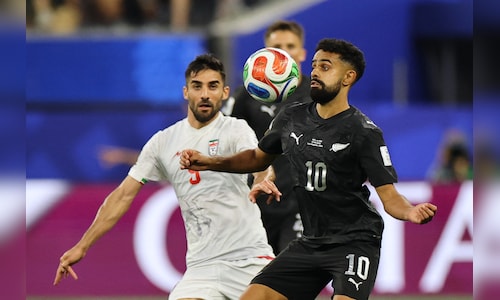
Born in Auckland to Punjabi parents, the 27-year-old had his World Cup debut after being named to the starting XI by New Zealand head coach Darren Bazeley. Sporting the iconic No. 10 jersey, Sarpreet played nearly the entire match, being substituted only in the 90th minute.
The attacking midfielder was actively engaged throughout the game, registering three attempts on goal. His best opportunity came in the 61st minute, although he couldn’t find a way past the Iranian goalkeeper.
Bazeley maintained confidence in Sarpreet until the end as New Zealand took the lead twice, only for Iran to equalize both times to finish the Group G encounter 2-2.
He played centrally in New Zealand’s 4-2-3-1 system.
New Zealand will face Egypt in their next Group G match on June 21 in Vancouver.
Just two days prior, Nishan Velupillay of Australia, another player of Indian descent, made his World Cup debut in his team’s 2-0 victory over Turkiye in Vancouver, Canada. The 25-year-old winger came off the bench in the 60th minute.
Velupillay was born in Melbourne to an Anglo-Indian mother and a Malaysian father of Sri Lankan Tamil descent.
Before this FIFA World Cup co-hosted by the USA, Canada, and Mexico, Vikash Dhorasoo of France was the only player of Indian descent to have participated in a World Cup match. The now 52-year-old midfielder played in two group matches during the 2006 World Cup in Germany, where France finished as runners-up.
Dhorasoo, whose ancestors hail from Vizianagaram in Andhra Pradesh, played only a few minutes across those two matches. He entered in the 84th minute during France’s 0-0 draw with Switzerland on June 13, 2006. Five days later, he came off the bench in the 88th minute for the 1-1 draw against South Korea.
Sarpreet played in India in 2018
Sarpreet previously played in India during the Intercontinental Cup in 2018 held in Mumbai. He faced off against notable players like Sunil Chhetri after making his New Zealand debut earlier that year. He participated as part of an U23 development squad, as New Zealand did not send their first team.
Sarpreet notched a goal against Kenya and provided both assists in New Zealand’s 2-1 victory over India.
India claimed the title, while New Zealand finished third in the four-nation tournament.
One year later, Sarpreet became the first player of Indian descent to compete in the German first division league when he debuted for Bayern Munich in 2019, transferring from the Australian A-League side Wellington Phoenix. He came on as a substitute against Werder Bremen.
Initially, Sarpreet played with Bayern’s reserve team in the third division, but his impressive form earned him a first-team debut under then-manager Hansi Flick.
Sarpreet made his first senior start for Bayern Munich on June 20, 2020, against SC Freiburg. He was part of the squad that won the Bundesliga title in the 2019-2020 season.
Following his time in Germany, he spent a season with Uniao de Leiria in Portugal before transferring to Serbian SuperLiga side FK TSC in 2025.
This year, he returned to New Zealand, playing in the A-League for Phoenix on loan from FK TSC.
After suffering an injury in February that sidelined him for eight weeks, he returned to action in April and subsequently made the New Zealand World Cup squad of 26. He has earned 24 international caps for New Zealand and scored three goals.
Sarpreet also represented New Zealand at the 2017 and 2019 FIFA U-20 World Cups.
Two other Indian-origin players
Two additional players of Indian origin—Samuel Moutoussamy from DR Congo and Tahsin Mohammed Jamshid from Qatar—are also part of their respective World Cup squads. Tahsin did not play in Qatar’s 1-1 draw against Switzerland on June 13, and it remains to be seen whether Moutoussamy will feature in DR Congo’s match against Cristiano Ronaldo’s Portugal on Wednesday.
Tahsin, who turns 20 on Tuesday, was born in Doha to Malayali parents who relocated to Qatar from Kannur in 2006.
The 29-year-old Moutoussamy was born in France to a Congolese mother and an Indo-Guadeloupean father of Tamil descent. The Indo-Guadeloupeans primarily descend from indentured workers who migrated mainly from South India in the late 19th century.
According to FIFA regulations, a player is eligible to represent a national team if a biological parent or grandparent was born in that country. The player must also possess the passport of the nation they are representing.
(With PTI inputs)