In an exclusive conversation with CNBC-TV18, Mathew emphasized that semiconductor development should not be seen in isolation; it necessitates the establishment of a comprehensive industrial ecosystem that includes manufacturing, suppliers, universities, and technology partners.
“We are seeking partnerships with like-minded entities to integrate into the ecosystem in India, as semiconductors must be viewed as a collective system,” he indicated.
Mathew referred to successful semiconductor and manufacturing centers in Asia, where numerous companies are involved in every phase of the value chain, which aids in cost reduction and enhances scalability.
“If we observe some of our neighbors, the way they achieved scale was through creating an ecosystem. For a single component, there are often thousands of companies,” he noted.
He believes India needs to boost local component production while reinforcing industry-academia collaborations to develop a sustainable flow of talent and innovation.
These remarks follow UST and Kaynes Technology’s initiative to establish an Outsourced Semiconductor Assembly and Test (OSAT) facility in Sanand, Gujarat. This facility, which was inaugurated by Prime Minister Narendra Modi, is being developed in phases, with expansion plans extending to 2028.
Mathew stated that the current emphasis is on launching Phase 1 operations and acquiring customers before advancing to more sophisticated packaging technologies in the subsequent phase.
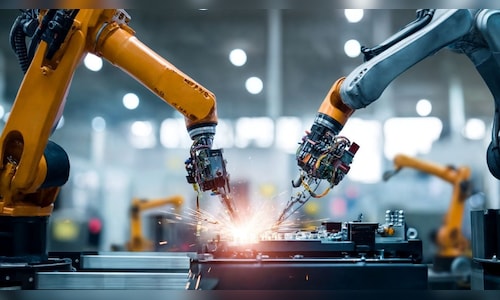
The executive also underscored the critical role of advanced manufacturing technologies in bolstering India’s semiconductor goals. He pointed out that some neighboring countries operate over a million industrial robots across manufacturing sites, granting them significant advantages in terms of scale and productivity.
“Manufacturing is making a comeback, semiconductors are returning, and AI is an area where we must execute intelligently,” he stated.
To stay competitive, India should promote an increased deployment of robotics, automation systems, and emerging technologies such as physical AI, he urged.
“We can achieve similar outcomes by attracting more manufacturing firms and fostering the development of robotics and humanoids in India,” Mathew added.
He noted that UST is also collaborating with companies from the US, Europe, and Asia to fortify India’s semiconductor ecosystem and introduce advanced technologies into the nation’s expanding manufacturing sector.
According to Mathew, the long-term prosperity of India’s semiconductor ambitions will hinge not just on fabrication and packaging facilities, but also on the robustness of the broader manufacturing ecosystem that underpins them.