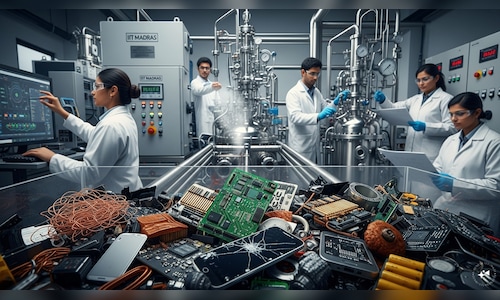
This facility is optimized to handle 100 tonnes per year of printed circuit boards (PCBs) and is situated at Bharat Heavy Electricals Limited (BHEL) in Tiruchirapalli, as noted in an IIT Madras announcement on Sunday.
The plant focuses on bare-printed circuit boards (PCBs), which are among the most hazardous and metal-rich elements found in electronic waste. These PCBs house considerable amounts of copper, lead, and tin—metals that can leach into soil and water, leading to long-term environmental and public health hazards if e-waste is improperly managed.
Transitioning from lab-scale chemistry to an operational unit, this breakthrough features a zero-discharge, single-acid method for metal recovery from electronic waste, presenting an adaptable model for scalability.
As India generates nearly five million metric tonnes of electronic waste each year, IIT Madras researchers have successfully built and showcased a scalable, zero-discharge pilot plant capable of extracting valuable metals from discarded electronics—without contaminating the soil, water, or air.
The technology for this pilot project emerged from an internal exploratory research initiative supported by IIT Madras.
Professor S Pushpavanam, YBG Varma Chair Professor in the Department of Chemical Engineering at IIT Madras, explained, “With India’s e-waste issue intensifying, this pilot plant provides a ready-to-scale model for clean metal recovery. The effort aligns with Make in India, the circular economy, and critical minerals safety. It also exemplifies how academic research can lead to technological advancements.” He emphasized that unique features of this pilot plant, compared to existing technologies, include the utilization of a single acid, enabling a zero-discharge process, completely developed by Indian companies based on IIT Madras research, along with automated operations that incorporate high safety standards in its design.
Also Read: Vaishnaw expects more companies to start production of memory chips in India