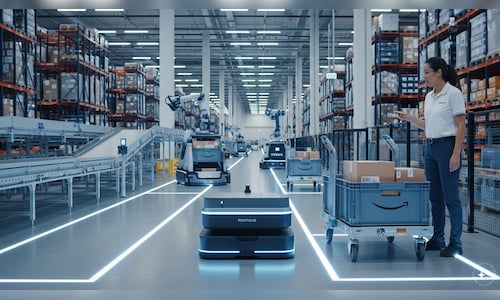
This announcement was presented at Amazon’s ‘Delivering the Future’ event in London, where the company highlighted the increasing role of artificial intelligence and robotics in warehouse operations.
Central to the announcement is the upgraded Proteus, an autonomous robot engineered to transport heavy carts and materials within fulfillment centers. Unlike its predecessor, which is limited to specific dock areas, the new Proteus can navigate entire facilities and respond to natural-language commands, facilitating conversational interaction with employees instead of requiring complex programming.
Amazon indicates that workers will be able to instruct the robot on tasks in a manner similar to directing a coworker, with the system autonomously managing routes, priorities, and timing. The aim is to decrease physically demanding tasks, such as moving carts that can weigh up to 400 kilograms, repetitive lifting, and extended distances within warehouses.
This development is crucial as it marks the next step in Amazon’s warehouse automation journey—one that fuses robotics with generative AI-like interfaces. While automation in fulfillment centers is not new, empowering frontline workers to engage with machines in plain language could potentially diminish the technical hurdles to adoption and create a more collaborative environment.
Importantly, Amazon seeks to mitigate long-held concerns regarding automation’s impact on employment. In tandem with its robotics advancement, the company announced plans to generate 25,000 jobs across European fulfillment centers in the coming years, asserting that automation is leading to new employment opportunities in maintenance, engineering, and reliability roles.
The next-generation Proteus is currently undergoing trials in Amazon’s labs and is slated for rollout across Europe in the first half of 2027.
In addition to Proteus, Amazon introduced an expansion of Vulcan, its robotic system equipped with a “sense of touch,” capable of identifying and managing objects in densely packed warehouse settings. Initially developed in the US, Vulcan is already being utilized for more sophisticated picking tasks at Amazon’s Hamburg facility in Germany.
Another robotic initiative, STARK, a collaborative tote-handling robot designed to assist employees in minimizing repetitive heavy lifting, is set to be implemented at 15 European locations by 2027 after successful trials in Barcelona.
This announcement occurs as global logistics and e-commerce firms increasingly invest in AI-driven supply-chain efficiencies amidst rising delivery demands and labor costs. For Amazon, robotics is evolving into not just a tool for enhancing warehouse productivity but a critical competitive advantage in the quest to fulfill orders more swiftly and economically.
In India, these advancements are likely to be closely followed. Amazon has been progressively expanding its logistics and fulfillment capabilities in the country, with technologies from global markets often being gradually integrated into its Indian operations.