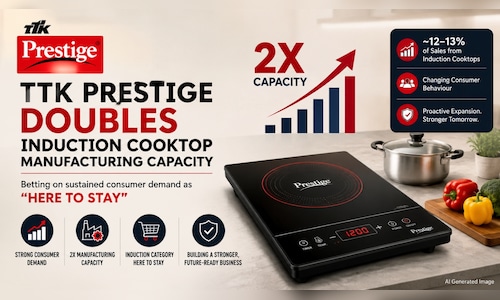
After the company’s earnings for the March quarter, Venkatesh Vijayaraghavan, CEO and Managing Director of TTK Prestige, shared with CNBC-TV18 that the kitchen appliance manufacturer has actively enhanced production capacity to address the growing demand for induction cooktops, which have experienced significant consumer acceptance in recent months.
“We have proactively expanded our production capabilities. We are now operating at nearly double what we were before the West Asia conflict,” Vijayaraghavan stated. “We’ve taken a calculated risk in trusting that this trend will persist.”
Initially, the company anticipated the rise in demand for induction cooktops to be a short-lived trend, but it seems that consumer behavior is shifting more permanently, he noted.
“People are beginning to purchase them more frequently due to these changes and potential impacts. Therefore, this category is here to stay,” Vijayaraghavan informed CNBC-TV18.
He mentioned that induction cooktops currently account for about 12–13% of TTK Prestige’s sales, and they are expected to play a more significant role in the company’s future as adoption increases.
Ongoing momentum from the March quarter has extended into the current quarter, partly due to uncertainty in the global economy.
TTK Prestige’s performance in the March quarter was also supported by the induction cooktop segment, though Vijayaraghavan indicated that growth was not solely reliant on it. He cited that induction cooktops contributed approximately 30–40% of the growth during the quarter, with the remainder driven by transformation initiatives implemented over the past two years.
“Alongside induction cooktops, we have also seen notable growth in other categories,” he added.
The company pointed out margin pressures stemming from rising commodity prices, especially for aluminum and stainless steel, which are crucial raw materials for its operations.
“Input prices have significantly impacted us, particularly with aluminum,” Vijayaraghavan remarked, noting that aluminum costs could rise by nearly 10% in the first quarter.
The company plans to pass a substantial portion of these cost increases onto consumers while also relying on internal cost-saving strategies to safeguard margins.
TTK Prestige Ltd. announced its March quarter results on 22 May, reporting a net profit of ₹37 crore, compared to a net loss of ₹40.7 crore in the same quarter the previous year.
The prior year quarter included a one-time impairment charge of ₹71.4 crore related to goodwill impairment at its UK subsidiary, in addition to higher expenses.
Revenue for the March quarter rose 12% year-on-year to ₹729 crore, with EBITDA increasing by 31% to ₹67 crore from ₹51 crore a year earlier. The EBITDA margin expanded by 140 basis points to 9.2%, up from 7.8% in the same period last year.
Also Read | TTK Prestige Q4 Results: Margins expand as profitability returns; Stock risesThis is an edited transcript of the interview.Q: It was a good performance. We did see decent revenue growth. EBITDA grew by over 30%, and we saw some growth in your profitability as well. A large part was undoubtedly appliance-led. Could you give us a sense of what proportion of your sales in the fourth quarter was contributed by induction cooktops, and how much of that is playing out in the first quarter as well, in light of the uncertainty that still continues? What’s this likely to settle at going forward on an annual run rate, according to you?
Venkatesh Vijayaraghavan: The last quarter has been a good mixed bag for us, driven by induction cooktops, of course. However, I would like to qualify that. In addition to induction cooktops, I think we’ve also witnessed reasonably good growth in other categories, driven by some of the transformation work that our organization has been undergoing over the last two years.
Induction cooktops, no doubt, have had an impact, but that would probably be limited to 30-40% of the upside. I think a significant portion of our growth is also underpinned by initiatives that have started yielding positive results for us over the last two years, and I’m confident that this will remain the story as we move forward.
In terms of the appliance side and the trend regarding induction cooktops, we observe that in the first quarter, we are experiencing demand driven by a sense of uncertainty around the global economy. This upward trend appears to be persisting into the first quarter as well.
Q: All right, just another follow-up on raw materials, because a large part of your raw material is obviously aluminum, and we’ve heard from Hindalco’s management just moments ago that aluminum prices are likely to rise globally as well. This geopolitical issue, along with the depreciating rupee, and higher input costs for many of these players, is increasing many of your input commodity costs as well. To that extent, what kind of margin pressure do you foresee? In the fourth quarter, obviously, you had the benefit of lower-priced inventory. As that gets eroded, how much of a price hike do you expect, and how much of a hit on margins do you expect?
Venkatesh Vijayaraghavan: Yes, there has been a substantial impact on input prices, particularly for aluminum, and we’ve also witnessed increases in stainless steel. These are crucial commodities for us. Aluminum has seen a steep rise in the first quarter, with price increases beginning toward the end of the previous quarter and continuing into the first quarter as well. I believe this could be around 10%.
A large part of it, we expect, will be passed on to consumers by the industry, so we aim to maintain our margins through some internal cost initiatives we have adopted. However, there is certainly margin pressure, and as you noted, the cost increase has been around 10%.
Q: Venkatesh, just a clarification on that. Since your revenue growth was robust in the fourth quarter and yet we still saw margin compression, are there any near-term targets you could share or any levers to improve this further? Also, regarding your induction cooktops, which are 12-13% of your sales and are a high-margin product, what sort of contribution do you anticipate overall going forward? Are consumers increasingly shifting toward this, or do you think this is merely a short-term trend?
Venkatesh Vijayaraghavan: No, I think while we initially believed this could be a fleeting moment, going by recent consumer feedback, a large number of customers have begun taking induction cooktops more seriously. The category used to serve as a complement to gas cooktops and was often overlooked. However, with the changes happening and the potential impacts anticipated, consumers are buying them more decisively. Thus, this category is indeed here to stay.
In my perspective, this is a significant opportunity for growth, and I believe that the growth will be sustainable. It may not reach the levels observed in the fourth quarter or what we are experiencing in the first quarter of this year, but it represents sustained growth compared to what we saw previously. Consequently, I expect margins from this category to remain healthy and assist us moving forward. It should be beneficial for the industry as well.
Q: Now, Venkatesh, in light of that, can we assume that induction cooktops will become a much larger segment of your business compared to the current 12-13%? Could it reach, say, 15-16% conservatively if this trend persists? And if the purchasing trend is strong, are you considering expanding capacity to meet this demand?
Venkatesh Vijayaraghavan: Yes, with the increasing acceptance of this category, we believe it will positively affect the organization. We are market leaders in this segment; in fact, we were the pioneers in innovation here and continue to lead the market. Thus, we are confident that stronger adoption trends in this category will drive our growth.
We have proactively expanded our production capacities. We are now operating at nearly double our pre-scenario levels. Therefore, we’ve taken a leap of faith to believe this trend will continue, which led us to double our production capacities.
Q: Just on the core business then, let’s discuss cookers and cooktops, including the Judge brand. Regarding the cookers, it reflects a barbell strategy, right? Premium products on the upper end, with newer materials also sold. Could you provide insights into the growth distribution at your premium segment by price as well as how much of that is driven by volume? Also, regarding Judge, which experienced about 50-60% sales growth, how is that likely to expand in FY27? So, both for the upper tier—volume and price growth—and the lower tier—volume and price growth.
Venkatesh Vijayaraghavan: We implement a dual strategy through both Judge and Prestige. However, currently, Judge represents a very small portion of our portfolio. It is an initiative we believe can support future growth, and thus we have been investing in that brand.
Currently, Judge accounts for no more than 2-3% of our total portfolio. Therefore, growth is mainly being led by Prestige, driven by premiumization and innovation initiatives. The Prestige brand continues to demonstrate significant turnaround potential, complemented by new market opportunities facilitated by Judge. That’s how I would categorize our current positioning.