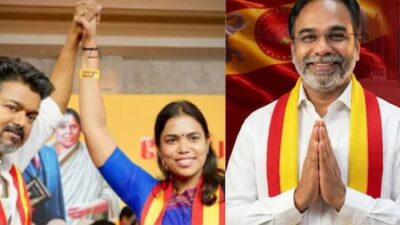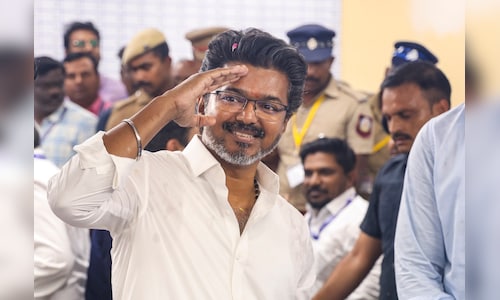
As his debut electoral campaign for Tamil Nadu entered its final phase, Vijay and his Tamilaga Vettri Kazhagam (TVK) strongly emphasized a ‘youth push’ in their strategy.
Children were encouraged, sometimes directly from the stage, to sway their parents’ decisions. This resulted in a surge of Instagram reels and WhatsApp videos where kids implored, teased, and, in some instances, mock-threatened their families into voting for TVK’s ‘whistle’ symbol in the 2026 Tamil Nadu Assembly elections.
நல்ல குடும்பம்.அம்மா நல்லா இருந்தாதான் குழந்தை நல்லா வளரும் pic.twitter.com/jVBEBdG8ia
— உளவாளி (@withkaran) April 21, 2026
It was raw, irreverent, and at times, unsettling.
However, as the Tamil Nadu election results on Monday demonstrated, it proved effective — Vijay’s TVK made electoral history in the state, emerging as the largest party and delivering a surprising defeat to the incumbent DMK, with the AIADMK falling to a distant third.
A Very Filmy Campaign
Challenging the Dravidian dominance of the DMK and AIADMK was always ambitious. So actor Vijay resorted to what he does best. He transformed his campaign into a ‘filmi-fied’ extravaganza filled with teasers, punchlines, fan engagement, and viral moments — similar to the rollout of a movie.
What unfolded didn’t resemble typical, forceful political messaging. The reels made by adolescents and younger fans of Vijay felt like exaggerated family banter meant for the camera, ideal for Instagram. It spread rapidly. In a state where ‘punch’ dialogues are integrated into daily conversations, the catchphrases resonated.
And, as every Tamil cinema requires an emotional connection, Vijay’s campaign also thrived in that aspect. Yet it didn’t offer sob stories, lengthy political pitches, or intricate ideological discussions. It presented a straightforward and relatable appeal — give Vijay a chance now, and he’ll listen for the next five years. This line alone generated its own collection of reels.
While social media portrayals appeared casual, effortless, and breezy, behind the scenes, the reality was markedly different. Vijay’s extensive fan network, comprising tens of thousands of volunteers, acted as hyperlocal digital distributors. The content didn’t flow in a top-down manner; instead, it ricocheted through friend circles, community chats, and school groups. The campaign didn’t merely deliver messages to voters; it empowered voters to share them.
Importantly, it confounded rivals. There was no singular narrative to oppose, no dedicated set of influencers to target. By the time the DMK responded, the conversation had evolved.
When Virality Crosses A Line
However, not all reactions were positive.
The same videos that supporters praised as “cute” raised alarms elsewhere. Critics highlighted the tone — the casual suggestion of violence, even if clearly theatrical — and the extent to which it became normalized.
The visuals were difficult to ignore: children playfully slapping parents, joking about poisoning food, chastising grandparents for political choices. What may have been dismissed as isolated skits developed into a discernible trend.
Deeper concerns surfaced as well. Child rights organizations raised alarms about the involvement of minors in political messaging, questioning consent, safety, and the long-term effects of such exposure. A formal complaint was lodged, claiming that the rhetoric had led to distress within families.
The criticism transcended a single campaign. It reflected a more profound unease within Tamil Nadu’s political landscape — a longstanding history of intense personality-driven devotion. From massive expressions of grief to extreme loyalty, the boundary between admiration and excess frequently becomes blurred.
Critics argued that this displayed the same impulse, repackaged for the digital age.
Yet, within the campaign, there was little indication of retreat. Vijay acknowledged the role of children, even attributing the high voter turnout to them. The message from the stage remained clear: keep pushing forward.
The Results That Changed The Conversation
When the votes were tallied on Monday, the magnitude of the disruption became apparent. TVK not only performed well; it reshaped the political landscape of the state.
In its debut election, Vijay’s party claimed the title of the single largest force, securing 108 seats, relegating both the DMK and AIADMK to behind positions. For a state that has predominantly alternated between the two major Dravidian parties since 1967, this was no minor shift.
The most significant surprise occurred in Kolathur, where DMK president and Chief Minister MK Stalin faced defeat. Several ministers lost their seats, and even Udhayanidhi Stalin encountered a challenging race before narrowly winning.
TVK also made inroads into traditional strongholds, including areas long regarded as AIADMK territory. With a vote share just under 35%, it became clear that this wasn’t merely a result of split votes, but a solid base.
In this context, the unconventional social media strategy allowed Vijay to bypass the usual filters — party hierarchies, media portrayals, and ideological scrutiny — and connect directly with households. Often, quite literally through children.
Difficult Questions That Remain
Did those viral, uncomfortable moments secure the election? Not by themselves.
However, they accomplished what campaigns labor for months to achieve. They inspired conversations, reactions, and shares, cutting through the noise of competing narratives. Most crucially, they compelled people to stop scrolling.
The pressing question now isn’t whether the strategy was effective. It’s whether the Tamil Nadu election results have legitimized it.