The company has already reported a consolidated revenue growth of over 22% in FY26 and is aiming for expansion in transmission and distribution, buildings and factories, oil and gas, industrials, and urban infrastructure. “If we achieve a 15% growth next year… we should surpass ₹30,000 crore,” Uplenchwar mentioned.
Uplenchwar also highlighted that the company is enhancing its capabilities in battery storage, hydrogen, and nuclear EPC projects, while also investigating international opportunities in desalination plants, sewage treatment facilities, airport ventures, and metro infrastructure.
Regarding reconstruction projects in economies close to Europe, he noted potential opportunities. Uplenchwar remarked that international water projects could begin to show improvement this year following better collection rates in India, with the company expecting to recover ₹1,600–1,800 crore in pending collections from the water segment by the end of the first half of FY27.
The company is targeting a margin enhancement of 75–80 basis points in FY27 after significant gains in the previous two financial years. He added that disruptions in West Asia have not affected execution or profit margins, although supply chain delays led to a revenue impact of around ₹200–300 crore in the January-March 2026 quarter of FY26.
Uplenchwar also stated that transformer shortages in the wider T&D market are not likely to hinder its focus on high-voltage projects like 765 KV and HVDC lines.
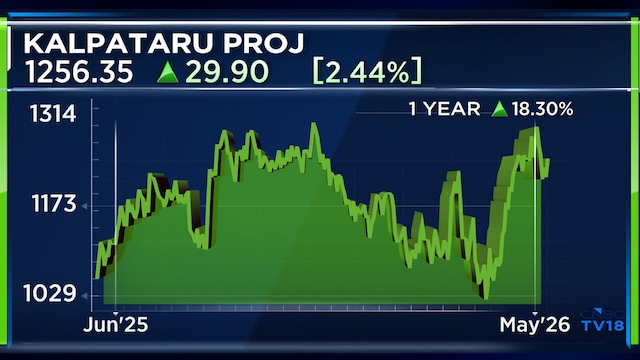
Kalpataru Projects, with a market capitalization of ₹21,474.65 crore, has experienced an over 18% rise in its shares over the last year.
This is an edited transcript of the interview.Q: FY26 experienced robust growth exceeding 20% in terms of revenues. You’ve provided a 15% guidance for FY27. Aside from concerns about West Asia, are there additional revenue risk factors present? Which segments do you foresee performing well in the future? Are there new segments under consideration?
A: We mentioned we would exceed 20% last year, and we are pleased to have surpassed 22% in consolidated revenue growth. Our five-year CAGR stands at about 16%, and our cautious outlook for 15% next year accounts for various disruptions, not limited to West Asia. Additionally, scaling responsibly requires us to enhance management bandwidth so our balance sheet remains secure, and our profit margins aren’t compromised.
If we achieve a 15% growth next year, given our ₹22,000 crore figure from last year’s close, we should exceed ₹30,000 crore, which is our goal.
Also Read | Welspun Enterprises expects 15-20% revenue growth backed by ₹20,000 crore order book
Rather than seeking entirely new regions, we are developing capabilities in several emerging areas such as battery storage, hydrogen, and the nuclear sector from an EPC perspective. We aim to expand some of our existing businesses abroad, particularly in water, where we see significant opportunities in West Asia, especially for desalination and sewage treatment projects. We intend to grow our urban infrastructure division overseas.
We are identifying numerous opportunities in reconstruction projects in developed economies near Europe, as well as in metro and airport initiatives.
As for our various business segments, we expect growth in transmission and distribution, building and factories, industrial operations, oil and gas, and urban infrastructure to contribute to our 15% target; however, we will be cautious about our railway business regarding growth, and we hope the water sector will start demonstrating positive trends in EPC projects overseas this year.
Q: West Asia currently accounts for around 8–9% of your order book geographically. Can you clarify whether there will be any margin impact in Q1FY27 due to issues in West Asia? How are your contracts structured there? Are they fixed or variable? Is pass-through a possibility? Has work in West Asia resumed, or are there concerns in that area?
A: Addressing your last point first, we have not experienced any work stoppages in West Asia concerning our 8–9% order book; construction is ongoing. While there may have been temporary safety concerns leading to brief work halts, these do not equate to an overall stoppage. Thus, no margin reduction has occurred due to these disruptions.
There were supply chain issues that resulted in postponed deliveries last year, contributing to a slight decline in our Q4 revenue growth, primarily due to the loss of ₹200–300 crore in revenue. However, I do not anticipate any margin impact from that 8% order book due to these disruptions going forward.
Q: What is your outlook on overall margins for FY27? You mentioned focusing on T&D, building, and factories, and oil and gas—all performing well and showing a favorable trend. Does this imply more potential for margin improvement?
A: Absolutely. We aim to achieve at least a 75 basis points (bps) improvement in margins this year, which follows a significant enhancement in the previous two fiscal years. Achieving a margin rise of 75 to 80 bps this financial year would be a notable accomplishment for us at the KPI level.
Q: There is considerable talk regarding a transformer shortage. Can you provide clarity on the current situation?
A: Yes, there is indeed a transformer shortage in the T&D sector, with many suppliers’ factories booked out for the next two to three years due to a surge in orders. However, we focus on the high-end T&D segment—765 KV and 800 KV HVDC lines.
Also Read | Govt imposes export tax on petrol for first time as West Asia war keeps oil prices high
Transformers for these projects may be procured by clients or by us, with strategic partnerships involved, which mitigates this challenge for us. While there could be issues with smaller transformers, they are not within our target segment, such as 200 KV transformers in India. Therefore, I’m not overly concerned.
For the full interview, watch the accompanying video

Q: Can you explain the current situation regarding collections? We previously discussed this topic, but could you elaborate? When do you anticipate these issues will be resolved, particularly with collections coming in? Is the first half of FY27 the target timeframe?
A: Reports indicate that by the end of H1, we still have ₹1,600–1,800 crore in collections pending, which hindered our water business growth last year. Otherwise, we could have seen greater revenue expansion. We were prudent in pursuing growth in the water sector to avoid compromising our balance sheet.
However, there have been improvements in collections during the last quarter of last year and in April this year. We hope to have these pending amounts collected by the end of H1 and expect substantial recovery throughout the year. Subsequently, we will shift our focus to water projects beyond India, unlike our approach over the past couple of years.