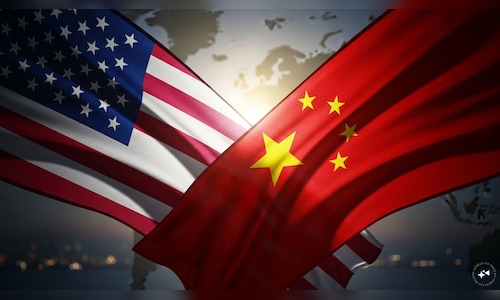
The announcement came just days before a scheduled meeting next week between U.S. President Donald Trump and Chinese President Xi Jinping in Beijing.
This exceeded analysts’ predictions and marked a notable improvement from the 2.5% year-on-year growth observed in March.
Imports increased by 25.3%, a deceleration from March’s 27.8% growth but still robust.
The upcoming summit between Trump and Xi occurs amidst a backdrop of various challenges, with efforts to resolve the conflict in Iran overshadowing typical points of contention.
“We anticipate that overall external demand will remain a strong driver of growth this year,” stated Lynn Song, chief economist for Greater China at Dutch bank ING, likely driven by China’s exports of semiconductors and automobiles.
In March, Chinese officials announced an annual economic growth target of 4.5% to 5%, slightly below last year’s 5% target, marking the lowest goal since 1991. Continued growth in exports is expected to support the broader economy, particularly as shipments to Europe, Southeast Asia, Latin America, and Africa have increased over recent months.
Alongside attempts to negotiate a peace agreement regarding the Iran conflict, trade discussions, including rare earth materials and U.S. tech restrictions on China, are likely to be key topics during the Trump-Xi summit. This follows a year-long truce in U.S.-China trade that was reached late last year when the two leaders last convened in South Korea.
Significant breakthroughs regarding export controls are improbable; however, the upcoming meeting might yield “incremental” steps to alleviate trade tensions, according to HSBC economists in a recent research report.
“Overall, China appears to have the upper hand,” wrote Leah Fahy, senior China economist at Capital Economics, in a note. “Nevertheless, the increased tariffs have not hindered China’s exports from continuing their upward trajectory over the last year, and Beijing has demonstrated its willingness to weather U.S. pressure.”
China’s manufacturing and logistics costs are also being driven higher by the oil and fuel price increases resulting from the Iran war, noted Wei Li, head of multi-asset investments at BNP Paribas Securities (China), while rising global inflation may impact consumer purchasing power in China’s overseas markets.
Nonetheless, China’s overall economy has remained robust compared to other nations, bolstered by its substantial oil reserves and more diversified energy resources.