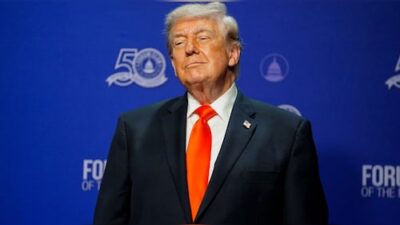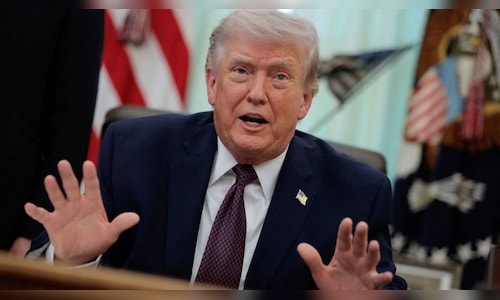
In a social media update, Trump claimed the EU “is not complying with our fully agreed to Trade Deal,” though he did not elaborate on his grievances in that post.
When asked by reporters on Friday about the increased import taxes as he left the White House for Florida, Trump stated that the EU was not adhering to last year’s trade framework, without specifying the cause of the friction. He expressed that the move to higher tariffs would “force them to move their factory production much faster” to the U.S.
Trump and European Commission President Ursula von der Leyen reached an agreement on the trade deal last July, which included a tariff cap of 15% on most products. However, a Supreme Court ruling earlier this year challenged the legal authority Trump relied on to impose that tax, leaving him to seek alternative justifications. Thus far, his administration has instituted a 10% tax while investigating trade imbalances and national security concerns to compensate for lost revenues.
The tariffs come at a time when the conflict involving Iran has severely impacted the global economy, raising inflation and stifling growth due to rising oil and natural gas prices resulting from the effective blockade of the critical Strait of Hormuz following U.S. and Israeli strikes that began in late February.
Simultaneously, Trump is facing mounting political pressure in the U.S. ahead of November’s midterm elections, attributed to rising inflation. Trump, a Republican, returned to the White House last year with the pledge to stabilize prices that surged following the government’s response to the coronavirus pandemic. However, increased energy prices led to an annual inflation rate of 3.3% in March, surpassing the level he had inherited.
Only 30% of U.S. adults approved of Trump’s economic management, according to a recent poll by The Associated Press-NORC Center for Public Affairs Research.
The European Parliament has been slowly finalizing last year’s trade pact, with expectations to conclude discussions next month. The EU issued a statement indicating that it was fulfilling its “commitments in line with standard legislative practice” and that should the U.S. “take measures inconsistent with” the agreement, ”we will keep our options open to protect EU interests.”
Officials in the Trump administration have not addressed inquiries regarding the tariff increase or the reasons behind Trump’s claim of an agreement violation. Relations between Trump and Europe have been tense; earlier this year, he threatened to take control of Greenland and criticized NATO allies for not providing sufficient support for the conflict with Iran.
Bernd Lange, chair of the European Parliament trade committee, expressed on social media that Trump’s tariff escalation on autos was “unacceptable” and criticized the Trump administration for “continuously breaking its commitments,” including those related to import taxes for steel and aluminum products.
Jennifer Safavian, CEO of Autos Drive America, representing American operations of foreign auto manufacturers, warned that the tariff increase “would jeopardize the progress already made in opening EU markets and enhancing the U.S. auto industry.”
Both the U.S. and the EU had previously affirmed their dedication to maintaining the trade framework, referred to as the Turnberry Agreement, named after Trump’s golf course in Scotland.
The status of the 2025 agreement faced uncertainty after the Supreme Court ruled this year that the president lacked the legal authority to declare an economic emergency and impose tariffs on goods from EU members and other nations.
The Trump administration has initiated trade investigations under Section 301 of the Trade Act of 1974 to replace the tariffs invalidated by the court. One of the investigations is examining whether trading partners have been inadequate in addressing forced labor issues, while another is investigating claims of overproduction that may undercut prices and disadvantage American manufacturers.
The alternative tariffs being considered by the Trump administration could potentially violate the EU agreement, although European Commissioner for Trade and Economic Security Maroš Šefčovič noted last week that relations with the U.S. had improved over the past year.
To implement higher tariff rates, Scott Lincicome from the libertarian Cato Institute’s Center for Trade Policy Studies indicated the president would likely invoke Section 232 of the Trade Expansion Act of 1962, which permits tariffs based on national security concerns.
Trump imposed 25% Section 232 tariffs on foreign autos in March 2025, but those tariffs were later reduced as part of the trade agreement with the EU.
Lincicome also remarked that Trump’s threats illustrate why such trade deals are often unreliable, depending heavily on informal agreements and the hope that Trump will not react negatively to certain issues.
The EU anticipated that the bilateral deal would save European automakers approximately 500 million to 600 million euros ($585 million to $700 million) monthly.
As of 2024, the value of EU-U.S. trade in goods and services reached 1.7 trillion euros ($2 trillion), averaging around 4.6 billion euros daily, according to statistics from the EU’s Eurostat agency.