Berkshire reported a robust first quarter, with operating earnings increasing 18% year-on-year, propelled by a recovery in its insurance segment. Insurance underwriting profits rose 28.5% to approximately $1.7 billion. The conglomerate’s cash reserves surged to an unprecedented $397.4 billion, as it continued to be a net seller of stocks—selling about $24.1 billion in shares while purchasing roughly $16 billion during the quarter.
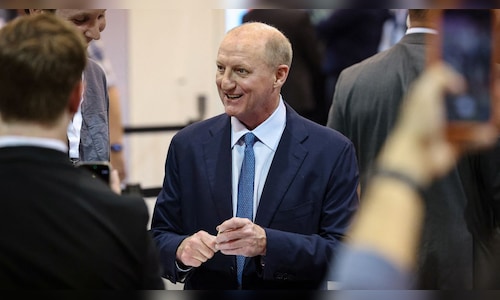
Seasoned investor Warren Buffett reiterated his confidence in CEO Greg Abel, commemorating the anniversary of the leadership change. “We couldn’t have made a better decision. that’s been 100% successful. [He’s doing] everything I did and more. He’s the right person,” Buffett remarked.
Abel honored Buffett’s legacy by raising a jersey emblazoned with the number “60” to the rafters at the CHI Health Center, alongside the late Charlie Munger’s “45,” symbolizing their long-standing contributions.Buffett praises Tim Cook
Buffett expressed admiration for outgoing Tim Cook, commending his leadership after Steve Jobs. “How would you like to step into the shoes of Steve and follow his record? It’s one of the miracles of American business management,” Buffett said, highlighting the value created from Berkshire’s investment in Apple.
Measured approach to AI
Regarding artificial intelligence, Abel exercised caution, stating, “We’re not going to do AI for the sake of AI.” He emphasized that any implementation must be “additive to our businesses,” focusing on specific use cases that generate value, while also acknowledging the potential risks for “humanity.”
This approach stands in contrast to a broader corporate trend toward AI, with companies like Snap Inc. and Atlassian citing AI in job cuts, and Allbirds shifting toward the technology.
Utilities to benefit from data centre boom
Abel also highlighted significant growth prospects for Berkshire’s utilities sector, fueled by increasing power demand due to data center expansions. He indicated that energy consumption from such facilities is already approaching 8% of peak load in regions like Iowa.
“If I look at our peak load… it’s at 8%… [Industry experts] aim to reach 5% to 10%, and we’re already at 8% [so] we see potential to grow that by 50% over the next five years or even more,” Abel asserted, emphasizing the scale of prospective demand.