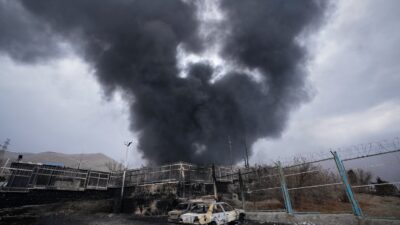
Over the course of more than five weeks of bombardment, US and Israeli airstrikes have targeted thousands of factories. The repercussions are echoing throughout Iran’s economy, leading to increased layoffs, all while Iranians contend with soaring prices.
In the last month alone, chicken prices have surged by 75%, while beef and lamb have risen by 68%. Many dairy products have seen a 50% price hike.
Conditions may worsen as the US enacts blockades on Iranian ports, severely limiting imports and oil exports that generate billions in revenue. Economic hardships sparked mass protests before the war, which were suppressed, and may again drive Iranians to the streets.
Nonetheless, Iran wields significant influence over the global economy through its control of the Strait of Hormuz. Iranian leaders assert they will only reopen this crucial waterway for international energy supply if the blockade is lifted and the conflict concludes.
They are counting on an economy designed to be self-sufficient over decades of international sanctions to endure the hardships longer than US President Donald Trump.
According to state media, Iran has lost at least 1 million jobs directly due to the war, as stated by Deputy Labour Minister Gholamhossein Mohammadi.
However, the ripple effect could place approximately 10 million to 12 million jobs at risk — half of Iran’s workforce — warns Iranian economist Hadi Kahalzadeh.
Israel claims to have targeted the industrial backbone of Iran’s paramilitary Revolutionary Guard, but the strikes extended much further, impacting facilities outside the group’s ownership.
Airstrikes have damaged around 20,000 factories, representing nearly 20% of the country’s production capacity, according to Kahalzadeh, a research fellow at Brandeis University. Affected facilities include Tofigh Daru, Iran’s largest pharmaceutical conglomerate known for manufacturing anticancer drugs, alongside optics and chemical development sites, as well as aluminum and cement facilities.
Perhaps most detrimental, Israel targeted Iran’s largest steel and petrochemical factories, commencing in a flurry of strikes right before the April 8 ceasefire. The major steel producers, Mobarakeh Steel and Khuzestan Steel, along with several smaller mills, have halted operations.
More than 50 petrochemical complexes have reportedly shut down, as noted by Iran’s semiofficial Jamaran news agency.
This has paralyzed Iran’s two biggest non-oil exports, and soaring prices are impacting everything from plastics and pipes to fabrics and packaging for staples like milk, butter, and cheese.
Airstrikes are not the sole factor in the economic decline. The internet has largely been disconnected since the protests began, severely affecting small and medium-sized businesses that rely on online sales.
Also read: Trump approval sinks to record low as war with Iran drives cost-of-living concerns
Even prior to the US blockade, Iranian strikes on the United Arab Emirates—which supplied around a third of its imports—prompted that country to sever trade ties.
Approximately 80% of rug and carpet manufacturers have ceased operations in the industrial zone of Kashan, the heart of Iran’s rug-making industry, according to the son of a rug maker. His family’s factory, which once employed 20 to 30 people and produced hundreds of rugs monthly, has shut down, though his father continues to visit the facility daily.
“Never have I heard my father so distraught,” said the son, who lives in the United States and requested anonymity for his family’s safety.
Kashan, home to numerous carpet manufacturers, “depends on the rug industry, and sadly, it’s been devastated,” he added.
Since the onset of the war, exports have plummeted and domestic sales are nearly non-existent. Prices for synthetic fibers have surged by 30%-50%, partly due to the impacts on petrochemical facilities, he noted.
Mehdi Bostanchi operates a ventilation and air conditioning factory, along with a second plant manufacturing household fans, employing over 1,130 workers in total. Both are still operational, but the HVAC factory relies heavily on the construction sector, which is experiencing a significant downturn.
Most new construction projects are on hold, while the cost of iron sheeting has more than doubled.
Bostanchi, a member of a council representing Iranian industrialists, remarked that “all sectors of the economy rely in some way on our petrochemical industry.” Even businesses not directly using steel or petrochemical products have agreements with those that do.
A chemical engineer at one of Iran’s largest private construction firms reported layoffs of half its 180 headquarters staff and the shutdown of a project with Mobarakeh Steel, resulting in 1,000 lost jobs.
A Tehran resident who resigned from his job as a consulting engineer just before the war expressed uncertainty about the new position he had lined up.
“Even as someone in the top 1% (of society), I find myself unemployed. I’m extremely anxious about my future,” he shared, adding that people’s savings are likely to be depleted in the coming weeks.
Both he and the chemical engineer spoke on condition of anonymity due to security concerns.
In January, hundreds of thousands protested due to worsening inflation, which escalated into calls for the end of the Islamic Republic, resulting in a violent crackdown.
Officials are attempting to reassure the public that Iran can withstand this economic hardship. The government has pledged to enhance unemployment benefits. However, the strain on Iran’s social security system is increasing even as funding is dwindling, as it heavily relies on profits from petrochemical companies and other key industries, according to Kahalzadeh.
Also read: US Iran War Ceasefire Live Updates: Iran reopens 6 airports as flights gradually resume
The US blockade threatens to sever export revenues: Iran achieved approximately $98 billion in exports in 2025, with nearly half coming from oil.
A complete blockade is challenging; about half of Iran’s non-oil trade occurs overland or through Caspian Sea ports, as noted by economic expert Esfandyar Batmanghelidj.
Iran has also developed considerable resilience and “preparedness for worst-case scenarios,” Batmanghelidj noted for the Bourse and Bazaar Foundation, a research organization focused on economic development in West and Central Asia.
Iran maintains substantial reserves of essential supplies. At the end of 2025, it had accumulated enough electrical machinery for nearly eight months, cement for about six months, and ample steel and iron for four months, with the possibility of further extending supplies through rationing.
Bostanchi believes Iran’s economy could rebound following the conflict, but much hinges on whether the country can negotiate the lifting of international sanctions.
“If we can’t alleviate sanctions in any agreements, then no, the optimistic forecast … will not materialize,” he stated.