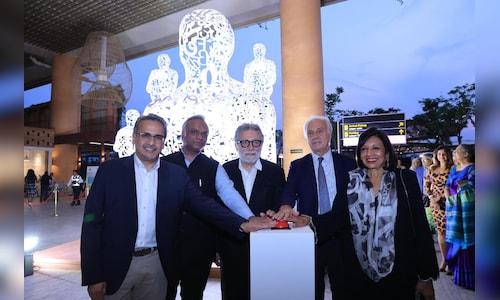
This installation not only embodies the city’s cultural essence but also aligns with a broader initiative aimed at enriching passenger experiences to foster engagement.
In an interview with CNBC-TV18, Hari Marar, Managing Director and CEO of Bangalore International Airport Limited, emphasized that modern airports are designed to provide various layers of engagement beyond simply ensuring timely departures.
“The role of an airport extends beyond merely facilitating timely flights; it’s about making the journey meaningful,” he remarked, noting that experiences can encompass a range of activities from shopping and dining to deeper cultural interactions with art.
Marar pointed out that art can alleviate passenger anxiety, a significant aspect of travel, which might indirectly promote increased spending.
“By reducing anxiety and calming individuals through remarkable art pieces, we may enhance non-aeronautical revenue, although that’s not the primary aim,” he elaborated.
Non-aeronautical income has emerged as a vital revenue source for airports worldwide, contributing significantly through retail, food and beverage, and various passenger services.
India’s infrastructure guidelines also advocate for investments in art. Regulations mandate that major infrastructure projects allocate approximately 1% of their total costs toward art. For instance, a project costing ₹10,000 crore would result in an investment of ₹100 crore, emphasizing the magnitude of these initiatives.
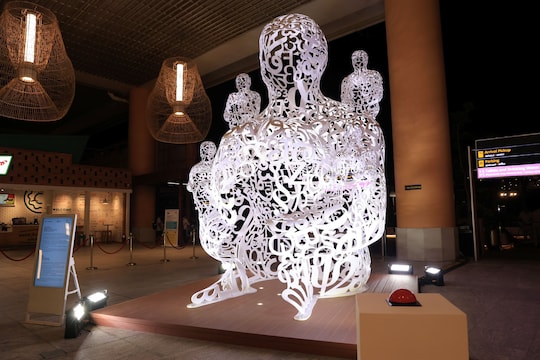
At Bengaluru airport, the art program features a blend of established and emerging artists, with support from the Karnataka government and corporate backing from the Biocon Foundation.
Kiran Mazumdar-Shaw, Chairperson of Biocon, emphasized that public art significantly contributes to creating more livable and culturally rich urban environments.
The installation also highlights the competition among airports worldwide to enhance passenger experiences and branding, with art, architecture, and design being key factors for differentiation.
Bengaluru airport has risen to fifth place in Skytrax’s World’s Best Art in Airport rankings in 2026.
Plensa, recognized for his large-scale public works in cities like Chicago, London, and Tokyo, referred to airports as symbolic spaces of connection.
“An airport represents the boundary, the link between one place and the world,” he stated, adding that the installation employs language as a metaphor for identity and human connection.
For airport operators, the approach is increasingly strategic: while art may not directly boost sales, it is increasingly viewed as a method to enhance dwell time, improve passenger comfort, and support non-aeronautical revenue in the long run.