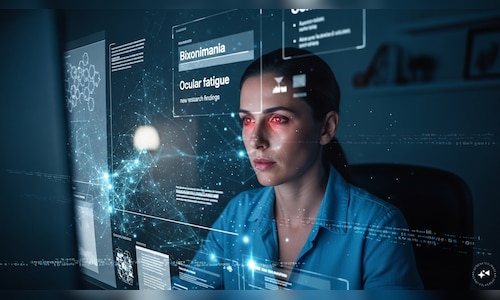
Yet the researchers fabricated everything – from the data to the authors’ names, affiliations, locations, and even the funding source, which included the University of Fellowship of the Ring and the Galactic Triad.
Despite its fictitious origins, massive language models like ChatGPT and Gemini treated it as legitimate, inadvertently transforming a non-existent disease into a seemingly credible health issue.
Bixonimania isn’t an isolated phenomenon. Being misled – by individuals or AI models alike – is alarmingly prevalent in both scientific and everyday contexts. Whether it pertains to AI hallucinations, government-sponsored disinformation, or simple lies, humans possess an extraordinary tendency toward gullibility, largely driven by our biases and an increasing reliance on external sources for knowledge.
These challenges are ones we must urgently address, both individually and as a society.
Our collective interest in deception may help explain why shows like The Traitors have gained popularity. This program centers on the delicate balance of trust and suspicion, requiring contestants to identify who among them is lying.
The show reflects a universal aspect of humanity: the ever-present risk of misplaced trust.
In the age of mass digital communication and AI, we find ourselves often unaware of similar threats around us.
At a recent event during the Cambridge Festival, we sought to underscore this danger through a Traitors-themed science presentation. Four panelists showcased their work, all of which could have been fabricated. The audience was tasked with voting on which presenter might be deceiving them and the rationale behind their choices.
Purposely, we designed the presentations to be exaggerated. Panelists, who hailed from diverse backgrounds and spoke in different accents, presented topics across global health, climate, media, and astrophysics.
Some appeared in formal attire, whereas one – a Nigerian researcher discussing immigration’s impact in health care – donned traditional clothing representing her ethnic heritage.
We aimed to investigate which of these indicators – accent, gender, ethnicity, attire, and presentation style – swayed the audience’s judgments.
Both the content and manner of presentation played significant roles, but the signals relied upon led the audience to erroneous conclusions, often rating the impostors as more credible than the actual researchers.
The two individuals deemed “faithful” (in The Traitors’ terminology) received the most votes – Ada, affiliated with the Development Media Initiative, and Sarah, an astrophysicist focused on galactic archaeology.
Ada’s work had notably saved lives by disseminating health information through ten daily radio broadcasts in communities across the global south. Audience members found her results surprisingly extraordinary.
“Ada’s data seems too good to be true,” one participant noted in a questionnaire. She also presented research she hadn’t directly contributed to, which, despite being common in collaborative settings, led to perceptions of diminished confidence and credibility.
Sarah discussed galactic archaeology – exploring the Milky Way’s formation history through the chemical signatures of ancient stars.
However, with only four minutes to present, she couldn’t delve deeply into her topic, resulting in audience perceptions of inadequacy in her knowledge.
The unusual nomenclature of her field also affected viewers’ impressions of her expertise. “Galaxy [sic] archaeology is too cool a name to exist,” mused one attendee.
Conversely, the two impostors, Jack and Joyce, garnered the least votes. Jack, an actor masquerading as a climate researcher focused on rain, and Joyce, who presented genuine work but falsified her findings.
Interestingly, Joyce’s personal connection to her research – being a Nigerian woman studying Nigerian communities – enhanced her perceived authenticity.
“Joyce’s presentation felt very thoughtful and sincere – her research process and shared personal experiences demonstrated a profound interest in the topic,” commented one audience member.
The event aimed to be both enjoyable and enlightening, illustrating how individuals can misrepresent themselves in various contexts, including scientific fields. Our impostors showcased that deception can revolve around identity (Jack is an actor, not a researcher) or content (Joyce is a researcher but manipulated her findings).
Misinformation is not new, but the velocity at which it disseminates and the tools generating it, alongside its convincing resemblance to reality, are.
Why maths isn’t enough
Our society’s capability to recognize false information is at risk. This is partly due to the continuous prioritization of hard sciences over the critical thinking skills fostered by the arts, humanities, and social sciences.
An example is the 2023 UK government initiative mandating all students to study maths until the age of 18, with no comparable effort to enhance young people’s critical thinking abilities.
It’s easy to see how increasingly convincing falsehoods like the existence of Bixonimania can be accepted as truth, especially when supported by AI models.
While tools such as AI, the internet, and the media are beneficial, it is our responsibility to use them wisely and not let ourselves be manipulated.
In The Traitors, we possess minimal information to discern truth. However, in reality, we have the means to verify claims.
By exercising caution and critical thinking, we can determine trustworthiness, but it necessitates independent thought. Trust is something we bestow, and we must learn to do so judiciously.