
Recently, as automation and analytics have lessened the demand for entry-level roles, many firms have transitioned to a flatter “diamond”: fewer juniors, a broader middle tier, and a more restrictive path to the upper echelons.
This model is now facing challenges.
In the past two years, leading consulting firms have initiated changes that would have seemed unimaginable a decade ago. Several global firms have either reduced or suspended hiring of graduates and apprentices while simultaneously experiencing unprecedented levels of senior attrition; reflecting pressure at both the bottom and the top of the talent model. Others have implemented new senior titles and roles aimed at retaining expertise without enlarging traditional partnership ranks, effectively separating experience from a linear progression.
These are not merely cyclical changes. They are fundamental responses to a shifting concept of value.
At the same time, the nature of consulting work is evolving. Large firms are heavily investing in internal AI platforms that automate research, analysis, and documentation: tasks that previously warranted large teams and extended timelines. Project teams are shrinking. Delivery timelines are shortening. Clients are questioning the justification of paying for effort when technology can increasingly provide results instantly.
Perhaps the clearest indication of disruption comes from outside the industry. Technology companies, once merely providers of tools to consultants, are now entering high-value advisory and delivery roles themselves: embedding engineers, implementing AI systems within client operations, and contracting based on outcomes instead of hours. By doing this, they are circumventing substantial segments of the traditional consulting value chain.
Collectively, these developments underscore a more profound issue. The challenge for consulting firms is no longer about rebalancing the pyramid or refining the diamond. It lies in the fact that the foundational talent architecture, built for a world where human labor scaled linearly with value creation, is ill-suited for an environment defined by intelligent, autonomous systems.
Artificial intelligence enhances productivity in ways that fundamentally alter who performs the work, how learning occurs, how risk is managed, and what clients are willing to pay for. Consequently, the result is not merely a flatter organization, but a radically different structure entirely.
The future of consulting talent resembles more of an X than a diamond.
Understanding the strain on the diamond
The diamond model signifies a true evolution. AI has automated many functions that junior consultants once handled: research, analysis, synthesis, modeling, documentation. Consequently, firms are relying increasingly on seasoned professionals who offer judgment, context, functional expertise, and industry depth.
However, the diamond model poses its own challenges.
Firstly, it diminishes the apprenticeship approach. Historically, consulting honed leaders through repeated practice—engaging in work until habits became second nature. When AI removes this repetition, experience fails to accumulate naturally.
Secondly, it centralizes risk. Value pools coalesce around a reduced number of highly compensated specialists, diminishing firms’ resilience.
Thirdly, and importantly, it does not fully meet client expectations. Clients are no longer paying for teams; they are seeking outcomes delivered with greater speed and reliability. Merely reshaping internal hierarchies does not rectify this equation.
The diamond model optimizes cost. The subsequent model must prioritize value.
The X Model: Consulting in a New Era of AI
The X model embodies a substantial reconfiguration of talent focused on human–AI collaboration, client outcomes, and continuous development integrated into daily operations.
It features four key shifts.
1. AI supplants leverage, not people
In the X Model, leverage is derived not from junior headcount but from AI functioning as a scalable execution mechanism.
AI systems now undertake the tasks that once justified large teams: data collection, benchmarking, drafting, testing, orchestration. Essentially, AI becomes the new “junior layer”: perpetually available, infinitely scalable, and significantly faster.
However, unlike humans, AI does not gain judgment through experience. This accountability shifts upward within the organization.
This transformation alters the economics of consulting. Margins are no longer safeguarded by pyramids; they are sustained by how effectively firms utilize AI to enhance expert judgment.
2. Early career talent transitions to AI orchestrators, not analysts
The base of the X is smaller, yet considerably more adept.
Entry-level consultants no longer spend years creating presentations or conducting analyses. Instead, they:
- Configure and oversee AI agents
- Validate outputs and identify errors or biases
- Translate insights into narratives relevant to clients
- Acquire end-to-end problem-solving skills much sooner
This is not a decline in rigor; it is a rapid acceleration of learning. Development shifts from “time served” to capability demonstrated, with learning occurring within the workflow and supported by AI copilots and real-time feedback.
Rethinking early-career development in a human-centric, AI-enabled workplace
Significantly, the transition from pyramid or diamond frameworks to an X model does not indicate a decrease in the importance of people or early-career talent. On the contrary, it signifies a renewed commitment to human development, especially at the outset of a consulting journey.
As AI takes over repetitive analytical functions, early-career consultants can commence engaging in comprehensive problem-solving, client interactions, and judgment-based tasks, aided by AI as a supportive learning tool rather than a substitute.
This redefines the apprenticeship model, making it more intentional, capability-oriented, and inclusive; equipping graduates with not only technical know-how but also the adaptability, judgment, and ethical understanding essential for thriving in a fast-evolving work environment and fluctuating client demands.
The apprenticeship model remains intact, but it undergoes redesign.
3. The middle segment evolves into a control tower
The intersection of the X represents the most vital talent category in the future organization.
These individuals encompass:
- Deep industry or functional knowledge
- Strong commercial responsibility
- The capability to oversee complex AI-driven workflows
- Accountability for outcomes, not mere tasks
Their roles increasingly resemble that of a control tower: monitoring live dashboards, guiding AI agents, intervening when necessary, and ensuring client impact.
This is where consulting transitions from providing recommendations to executing transformations.
4. Partners shift from oversight to outcome responsibility
As AI accelerates execution, partners devote less time to reviewing work and more to:
- Framing client ambitions and value propositions
- Orchestrating ecosystems composed of AI, partners, and client teams
- Pricing and contracting based on outcomes rather than effort
- Building trust in human-AI decision-making systems
This aligns directly with the direction clients are heading. As AI hastens delivery, hourly billing loses its credibility. Value-based pricing, subscriptions, and outcome-linked models become imperative.
Partners unable to make this transition will face obsolescence. Not because AI usurps their roles, but because clients will.
How the economics of consulting transform in the X Model
For decades, the economics of consulting were rooted in leverage. Firms marketed human effort, increased revenue through headcount, and safeguarded margins by managing utilization and pyramid structure. Even when engagements revolved around outcomes, pricing ultimately relied on time and capacity.
The X model disrupts this rationale.
As AI streamlines delivery, effort ceases to be a valid representation of value. Clients increasingly question the rationale of compensating for teams and timelines when intelligent systems can yield results more efficiently and at significantly lower costs. Within this landscape, the traditional economic underpinnings of consulting begin to crumble.
Three key shifts define the new economic landscape:
From selling effort to selling outcomes
In the X model, revenue dissociates from utilization. AI significantly reduces delivery time, rendering hourly pricing economically unsustainable. Value shifts upstream—to problem framing, judgment, orchestration, and accountability for results.
Consequently, consulting economics pivot toward fixed fees, subscriptions, and outcome-linked frameworks. This does not diminish revenue potential; rather, it mandates precision. Firms must clearly outline what they are accountable for—and what they are not.
Margins are no longer maintained through leverage
In pyramid and diamond frameworks, leverage absorbed costs and safeguarded margins. AI removes this cushioning.
In the X model, margins are safeguarded by design: through the effective deployment of AI as an execution layer, the clarity with which human judgment is applied where machines cannot decide, and the thoroughness with which outcomes are scoped and managed. Economic accountability ascends. Partners are no longer shielded by structure; they are responsible for the economics comprehensively.
This transformation makes margin erosion more transparent—and manageable.
Credit, targets, and collaboration must be reimagined
Value in the X model is collectively generated: by human judgment, AI systems, and ecosystems of contributors. Yet accountability cannot be collective if sustained ambition is to be preserved.
This highlights the limitations of traditional performance models. Equal credit undermines targets; neglecting contributions stifles collaboration. The solution lies not in universal sharing, but in clearly designed economic roles: distinct outcome owners, acknowledged contributors, and explicit orchestrative responsibilities.
Targets reflect ownership, not participation. Collaboration is encouraged, but accountability remains singular.
Consulting Economics: Diamond model vs. X model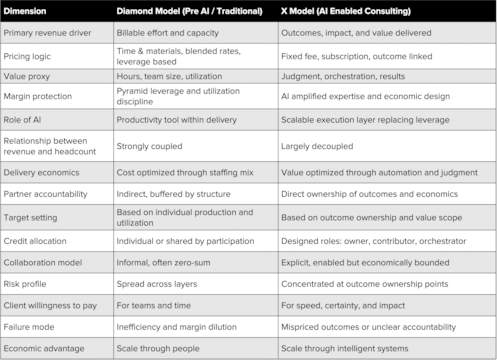 Implications for leaders
The most challenging transition in the X model is economic, not technological. Leaders must abandon familiar metrics—hours, utilization, headcount—and confront more complex questions:
- Where is value genuinely created?
- Who has accountability for outcomes throughout?
- How do we reward collaboration without undermining accountability?
Firms that shy away from these inquiries will drift into a perilous middle ground: AI-enabled in delivery but constrained by legacy economics. Those that engage with these questions directly will recognize that the X model does not diminish ambition—it clarifies goals.
In an AI-driven consulting economy, value is no longer obscured within a pyramid. It is explicit, owned, and priced accordingly.
Defining leadership within the X model
Leadership experiences a similarly profound transformation.
As AI assumes analytical and execution roles, leaders generate value less through expertise and oversight, and more through context, judgment, and system design. Their roles evolve in three dimensions:
From command to context
Leaders establish direction, guardrails, and success metrics; subsequently empowering teams and AI agents to operate within those parameters.
From answers to judgment
When AI can generate options instantaneously, leadership value lies in determining which questions are significant, when to intervene, and how to navigate trade-offs.
From managing talent to cultivating capability
Leaders become responsible for skills, trust, and resilience at scale; not merely utilization and advancement.
The premium now shifts toward leaders who can harmonize strategy, technology, and personnel—rather than optimize any one facet in isolation.
Learning becomes integral to operations
The X model functions effectively only when learning is no longer a standalone function.
In an AI-empowered organization:
- Development is seamlessly integrated into daily tasks
- Skills are continuously validated, not self-reported
- AI offers coaching, reflection, and challenges in real time
- Career growth is based on skills and contributions, not tenure
- This addresses the apprenticeship issue that the diamond model creates. Individuals learn through practical experience, supported by intelligent systems that reveal feedback, stretch assignments, and anticipated skill gaps.
The consulting firm evolves into a dynamic learning entity, rather than a rigid hierarchy.
Conclusion: Implications for consulting leaders
The transition from diamond to X represents not merely a workforce adjustment. It is a strategic reconfiguration.
Leaders must tackle four challenging questions:
- Where does judgment hold the most significance, and how do we safeguard it from dilution?
- How do we cultivate future leaders when repetition is phased out?
- How do we price value when AI diminishes effort?
- How do we establish trust in AI, in humans, and with clients… at scale?
Firms that regard AI solely as a productivity tool will gradually diminish their relevance. Those that concurrently redesign talent, learning, and economics will reshape the industry.
If the X model clarifies how consulting talent is reorganized in an AI-driven context, high performance will determine whether the model provides real value.
AI does not inherently spawn high performing organizations. Often, it does the reverse: amplifying speed without direction, output without insight, and activity without results. The distinction lies not in technology, but in organizational culture and leadership.
The future of consulting will not be defined by those with the largest pyramids, or even the most refined diamonds, but by those who master the X: where human judgment and machine intelligence converge to yield outcomes that truly matter to clients.
Redefining high performance in an AI-enabled consulting firm
In traditional consulting environments, high performance was frequently equated with intensity: long hours, extraordinary effort, and individual genius. In the X model, that definition has evolved.
High performance now shifts from effort to orchestration, and relies on four key conditions:
- Clarity of outcomes: Teams are evaluated based on results achieved, not merely the volume of work produced. AI accelerates execution, but leadership clarity and governance ensures it directs the right efforts.
- Trust coupled with accountability: Consultants need to trust AI outputs to act on them and be accountable for when human judgment should intervene.
- Learning embedded in work: Skills are developed continuously through tangible assignments, supplemented by AI feedback and coaching, rather than through isolated training sessions.
- New skills ecosystems: AI reduces friction, but humans still contribute judgment, creativity, and ethical decision-making. High performing cultures are designed for growth, with change as a focal point.
In this framework, performance is redefined from sheer effort to creating evolving systems that enable both people and machines to excel in tandem.
Why integrated consulting models hold structural advantages
These cultural and leadership requirements reveal a critical structural divide within the consulting sector.
Pure consulting firms were established on the foundation of selling effort. As AI diminishes that effort, they must simultaneously reinvent their pricing structures, delivery models, talent framework, and culture—often while clinging to outdated economics.
Conversely, consulting embedded within a comprehensive technology and services organization begins from a distinct perspective.
In integrated models—where consulting exists alongside execution, platforms, and long-term operations—three advantages arise:
- Proximity to outcomes
Consulting teams are closer to execution and operations, allowing for clearer accountability regarding results instead of just recommendations. - AI as a tangible reality, not just an idea
AI is woven into delivery, monitored in real time, and refined through ongoing use, making human-AI collaboration palpable and credible. - A performance culture shaped by results
High performance norms are based on what is effective over time, not just what convinces in a boardroom.
In this setting, consulting acts as a catalyst: enhancing the organization’s capacity to implement complex change, rather than merely offering a standalone advisory service.
As consulting evolves from diamond to X, competitive advantages will not solely arise from organizational charts or AI investments. They will stem from cultures that nurture judgment, leaders who craft and govern systems rather than merely managing activities, and operating models that connect insights directly to results in an increasingly disruptive business environment akin to the revolutions seen with electricity or the internet.
The future of high-performance consulting belongs to organizations adept at integrating human judgment, intelligent machines, and execution on a large scale; and making that integration their defining advantage.