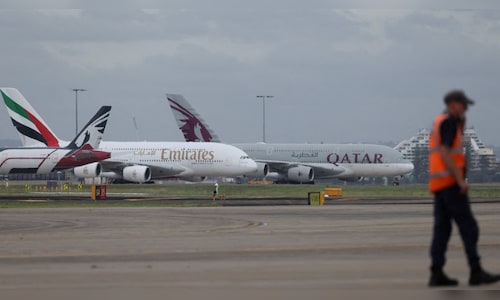
Major travel hubs worldwide, including Dubai, Doha, and Abu Dhabi, experienced prolonged shutdowns. Thousands of passengers found themselves stranded due to cancelled flights and altered routes designed to avoid dangerous regions.
Major airports shut and flights disrupted
Significant transit airports like Dubai International and Doha’s Hamad International Airport encountered substantial disruptions. Dubai International, the primary hub for Emirates, reportedly saw more than 600 scheduled flights cancelled. Similarly, Doha’s airport temporarily ceased operations, affecting Qatar Airways’ global network.
Other airports were also impacted. Tel Aviv’s Ben Gurion International Airport and Jeddah’s King Abdulaziz International Airport reported service interruptions as airlines attempted to navigate closed airspace and safety issues.
As reported by Reuters, airlines across Europe, Asia, and the Middle East cancelled flights to cities such as Tel Aviv, Beirut, Tehran, Dubai, and Riyadh.
Emirates and Qatar Airways were significantly affected, with each airline cancelling over 400 flights by late Sunday, according to flight tracking data. Qatar Airways also temporarily suspended flights due to the closure of Qatari airspace.
Airlines suspend and reroute services
Numerous international airlines announced cancellations or route adjustments. Aegean Airlines halted flights to and from Tel Aviv, Beirut, and Erbil until March 3. Air France cancelled services to Tel Aviv, Beirut, Dubai, and Riyadh through the same date.
KLM warned of potential disruptions to Dubai, Riyadh, and Dammam through March 6 and suspended flights to Tel Aviv.
British Airways permitted passengers traveling between London and cities like Abu Dhabi, Amman, Bahrain, Doha, Dubai, and Tel Aviv to modify their travel dates without additional fees up until March 15. Refunds were reportedly provided for travelers booked up to March 8.
Cathay Pacific suspended flights to Dubai until March 5 and halted Riyadh services through March 3. Emirates and Etihad Airways also paused operations from their Dubai and Abu Dhabi hubs starting March 2.
Several airlines, including ITA Airways, Lufthansa, LOT Polish Airlines, Malaysia Airlines, Norwegian Air, Singapore Airlines, Scoot, Turkish Airlines, and Wizz Air, likewise suspended or rerouted services.
Japan Airlines cancelled its Tokyo-Doha flights, affecting approximately 1,000 passengers across six services. Airlines cited safety risks, restricted airspace, and operational constraints as the primary reasons for these decisions.
Indian carriers face heavy impact
The crisis has significantly impacted Indian aviation. IndiGo, which services numerous routes to Dubai, Doha, and Jeddah, reported the highest cancellation rates among non-West Asian airlines.
At Delhi airport, 410 flights operated by Indian airlines were cancelled on February 28. On March 1, at least 350 flights were cut, and by March 2, around 300 flights were anticipated to be affected as airlines continued modifying schedules.
The civil aviation ministry indicated that Indian carriers cancelled roughly 350 international flights on Sunday. The Directorate General of Civil Aviation (DGCA) is collaborating with airlines and related agencies to manage the situation.
A Passenger Assistance Control Room has also been established to assist stranded travelers.
Air India extends suspension and changes routes
Air India has prolonged the suspension of all flights to and from the UAE, Saudi Arabia, Israel, and Qatar until 11:59 pm IST on March 2. This deadline has lapsed, and further updates are awaited as the situation evolves.
The airline also cancelled six Europe-bound services on March 2, including Amritsar-Birmingham (AI117), Birmingham-Delhi (AI114), Delhi-Zurich (AI151 and AI152), and Delhi-Copenhagen (AI157 and AI158). On Sunday, it had cancelled 50 international flights.
Flights to North America and Europe are being rerouted. Services to New York’s JFK and Newark Liberty International Airport are making technical stops at Rome’s Fiumicino Airport.
With Iranian and Iraqi airspace closed, Air India aircraft are taking routes through Oman, southern Saudi Arabia, and Egypt. This has extended travel time to Europe by 30 to 40 minutes and raised operational costs.
The airline stated it is reassessing safety and airspace availability before finalizing schedules and is notifying affected passengers while arranging alternative travel options.
SpiceJet to operate four special flights from Fujairah
On March 3, SpiceJet announced plans to operate four special flights from the United Arab Emirates’ Fujairah airport. This initiative aims to assist Indian citizens stranded due to ongoing flight disruptions caused by the West Asia crisis.
These flights are intended to repatriate travelers who have been unable to return home following airspace closures in the Gulf region that resulted in widespread cancellations and suspensions.
The airline indicated that this action seeks to support affected passengers while regular schedules remain uncertain amid ongoing safety concerns and limited corridor availability.