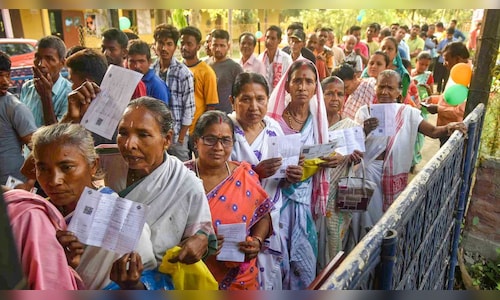
With approximately 3.5 million voters, this community plays a crucial role in over 35 seats, particularly in eastern Assam, and can affect the outcomes in at least 10 additional constituencies in the 126-member assembly.
Their persistent demands, such as Scheduled Tribe (ST) status, increased daily wages, and land rights, have returned to the forefront of political discussions.
The ruling BJP has showcased its welfare initiatives over the last decade, asserting that the living conditions of tea garden workers have significantly improved.
The party has specifically highlighted its efforts to secure land rights within tea estates.
“The community is no longer seen as second-class citizens. From education to infrastructure, real progress has been made,” stated Dulen Nayak, president of the BJP Tea Morcha, citing programs such as schools, roads, and welfare initiatives.
The BJP also pointed out wage increases during its administration, jumping from ₹126 in 2016 to ₹280 in the Brahmaputra Valley, and from ₹105 to ₹258 in Barak Valley, promising further increases to ₹500 in phases if re-elected.
Additional initiatives include job reservations, dedicated seats in medical colleges, and the promotion of cultural heritage such as the Jhumoir dance.
In response, the opposition Congress contended that these advancements have not resulted in substantial real-world improvements.
Atuwa Munda, president of the Assam Cha Mazdoor Adivasi Congress, criticized the land rights program as merely superficial.
He claimed that the recently issued “digital pattas” lack legal backing and proper procedures, cautioning that they could lead to future conflicts between workers and tea estate management.
“These are merely election-time spectacles rather than lasting solutions,” he remarked.
Munda also condemned the BJP for not fulfilling crucial promises, especially regarding ST status and increasing wages to Rs 351.
While he acknowledged the recent wage increase to ₹280, he contended that a one-time financial aid of ₹5,000 offers minimal long-term relief.
“The government should have focused on structural wage reforms through ongoing discussions with tea garden owners,” he noted.
In its election manifesto, the Congress has committed to granting ST status to the community while revitalizing the tea sector with industrial minimum wages and expanded welfare programs.
Meanwhile, smaller factions like the Jharkhand Mukti Morcha (JMM) have also entered the competition, trying to capture the tea tribe vote, yet their electoral influence remains unclear.
Despite active campaigning from all sides, fundamental issues like ST recognition and significant wage hikes continue to be unaddressed. Currently, the tea tribe community seems to be carefully considering its options, fully aware of its critical electoral power in shaping Assam’s political landscape.
Voting in Assam is scheduled for April 9, with the results to be announced on May 4.