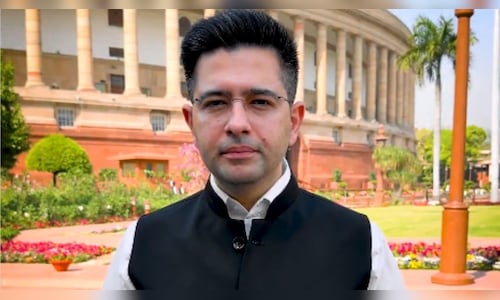
In light of this development, the internet is buzzing with a pressing question: Can a political party remove its Rajya Sabha MP?
Key Points
Following the decision regarding Chadha, the AAP referred to it as an internal reorganization. However, tensions increased when Chadha publicly questioned this action.
“Have I done something wrong?” he inquired in a video message posted on social media, asserting that he addresses public concerns whenever he has the chance to speak in Parliament.
“Is expressing these views a crime or an error? Why would anyone wish to silence me? Don’t confuse my silence for defeat,” he stated.
Silenced, not defeated
My message to the ‘aam aadmi’
—
खामोश करवाया गया हूँ, हारा नहीं हूँ‘आम आदमी’ को मेरे संदेश pic.twitter.com/poUwxsu0S3
— Raghav Chadha (@raghav_chadha) April 3, 2026
Is it possible for a political party to remove its Rajya Sabha MP?
Rajya Sabha members are elected indirectly by the elected members of State Legislative Assemblies using proportional representation with a single transferable vote. A Rajya Sabha MP serves a term of six years, with one-third of members retiring every two years.
This guarantees that once elected, their membership is safeguarded by the Constitution and is not reliant on party leadership.
Ultimately, a political party cannot remove its MP from Parliament, even in times of disagreement.
However, a party can limit the MP’s role within its structure, which includes posts like deputy leader, and has the authority to choose who represents it in discussions and debates.
In Raghav Chadha’s situation, he has lost his role in AAP’s parliamentary hierarchy. As Deputy Leader, he was a part of the party’s official representation in the Upper House. That position, however, is no longer his.
He continues to hold his Rajya Sabha MP status, which remains unaffected by the party’s actions.
A similar situation unfolded in 2024 when Swati Maliwal had a significant fallout with party leadership after accusing a close aide of former Delhi Chief Minister Arvind Kejriwal of assault within the Chief Minister’s residence.
Even if a party expels its MP, their parliamentary membership persists.
An MP’s membership typically concludes only under specific circumstances: if the member voluntarily resigns, gets disqualified for defying the party whip, or relinquishes their membership under the anti-defection law.