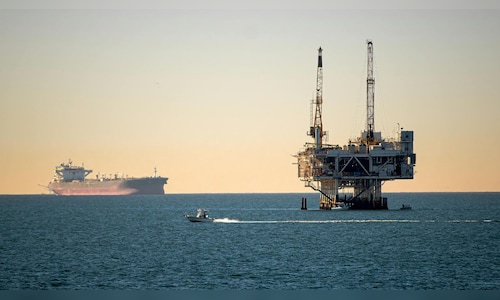
The ongoing crisis has led to soaring crude prices.
According to S&P Global, which tracks market data, the spot price for current physical cargoes of Brent crude oil soared on Thursday to $141.36, marking the highest level since the 2008 financial crisis.
This price reflects a $32.33 increase over the June delivery Brent crude futures contract, which closed Thursday at $109.03.
The spot price indicates the demand for Brent oil scheduled for delivery within the next ten to thirty days. Due to the substantial disruption caused by Iran’s closure of the Strait of Hormuz, there is a currently limited physical supply, evident from the elevated cost of expedited oil delivery.
Discussing the situation with CNBC International, Amrita Sen, founder of Energy Aspects, remarked, “The futures price is almost giving a false sense of security that things are not that stressed.”
Also Read: India’s ‘Mounjaro brides’: weight-loss injections become part of pre-wedding preparation
Sen added, “You are witnessing it, but the financial market is somewhat camouflaging the true tightness that is evident elsewhere.” Currently, the price for a barrel of diesel in Europe is nearing $200, she noted.
Chevron, a leading name in the fossil fuel industry, highlighted this trend.
Recently, company CEO Mike Wirth warned that the futures price does not accurately reflect the extent of the oil supply disruption caused by the Strait’s closure. Wirth stated that market perceptions are based on “perception” and “limited information”.
Speaking at the CERAWeek by S&P Global energy conference in Houston on March 23, Wirth elaborated, “There are very real, physical manifestations of the closure of the Strait of Hormuz that are making their way around the world and through the system that I don’t believe are fully accounted for in the futures curves on oil.”
Following President Donald Trump’s announcement of continued military actions against Iran, traders expressed concerns about long-term disruptions to the oil supply, resulting in US oil prices settling over 11% higher and Brent rising more than 8% during chaotic trading on Thursday.
Brent crude futures concluded the day at $109.03 per barrel, up $7.87, or 7.78%. The US-based West Texas Intermediate crude futures witnessed their largest absolute price increase since 2020, climbing $11.42, or 11.41%, to $111.54 per barrel.
Both benchmarks remained below the earlier peaks of roughly $120 per barrel during the ongoing conflict.
Trump indicated that military actions would be escalated, but did not specify a timeline for the conclusion of hostilities or provide details on actions that might lead to the reopening of the Strait of Hormuz.