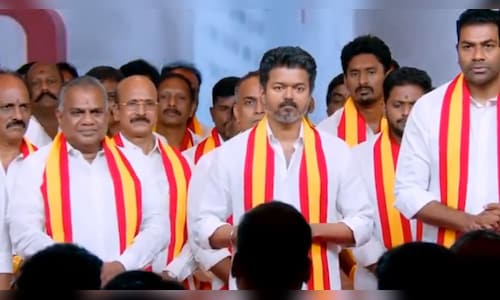
This is not the first time a third option has emerged; rather, it’s the first time it has gained the people’s mandate. The victory of actor-turned-politician Vijay’s Tamizhaga Vettri Kazhagam (TVK) in the 2026 elections stands out precisely for this reason. Yet, the final seat count presents a challenge: both for Vijay and for the people of Tamil Nadu.
Since 1967, Tamil Nadu has not seen a coalition government. Both DMK and AIADMK have historically been reluctant to share power, even with their allies. This reluctance led the DMK to form a minority government with external support in 2006 instead of choosing a traditional coalition. Vijay’s TVK finds itself in a more challenging position than the DMK did back then.
With 107 seats (leads/wins as of this article’s publication), TVK is 11 seats shy of the required number for Vijay to form a government outright. His pre-election rhetoric has been critical of both the DMK and the AIADMK.
He singled out the DMK as his main political rival, accusing it of corruption, dynastic politics, and a failure to serve the people, which has led to administrative and governance breakdowns in the state. His critique of the AIADMK focused on condemning its current leaders as “sellouts” to the BJP, betraying both Tamil autonomy and the party’s legacy. His attacks seem to have resonated effectively.
Consequently, forming alliances with either the DMK or the AIADMK is now untenable for him. This dilemma places him in a precarious position. To secure the numbers necessary for a government, Vijay must lure a few successful candidates from other competing parties. He may find support from the Congress and Dr. Anbumani Ramadoss’ Pattali Makkal Katchi (PMK).
The greater ongoing challenge will be to maintain these newly formed alliances, resisting any pressures they may face to defect. He must also navigate political maneuvering and ensure his own supporters remain loyal.
To achieve this, he will need to offer irresistible incentives, as he hasn’t been in power long enough to use threats effectively. His influence over national parties is also limited.
Though Vijay has garnered the support and votes of many Tamil voters, and has delivered a stern wake-up call to the DMK and AIADMK, he still faces numerous hurdles before he can occupy the Chief Minister’s chair comfortably.
While forming a government is a significant milestone, maintaining its stability for the next five years and fulfilling pre-election promises amidst fragile dynamics and egos presents an entirely different set of challenges. The potential pitfalls are numerous.
Another critical aspect to navigate is economic. Since the COVID-19 pandemic, Tamil Nadu’s economy has exhibited growth rates of 8% to 11%, showcasing one of the most robust rebounds among all states in the country. However, this recovery has come at the expense of a persistent revenue deficit and escalating debt levels. Some commitments outlined in TVK’s manifesto could exacerbate these deficits.
While the manifesto boasts ambitious welfare schemes, including gold rings for newborns, gold and silk sarees for brides, six free gas cylinders per family, and monthly financial support for female heads of households and unemployed degree or diploma holders, it lacks specific industrial or commercial strategies to catalyze economic growth. The aggressive welfare plans, leaning towards cash benefits and being less targeted, may increase the financial burden on the state, potentially affecting the economy in the short term.
Moreover, throughout his campaign, Vijay has not disclosed who will be part of his core team or cabinet if he wins. The qualifications of individuals responsible for crucial portfolios like commerce, finance, or home remain ambiguous, as many who campaigned on a TVK ticket are relatively unknown. In contrast, the DMK and AIADMK had established systems in place due to their repeated governance of the state. TVK will essentially be building from the ground up.
No matter how you analyze the situation, significant uncertainty lies ahead for Tamil Nadu politics, for Vijay’s TVK, and for the Tamil electorate. The dramatic conclusions his films are known for are still some scenes away.
In his film Thuppakki, Vijay famously declared, “I am waiting!”. So too is anyone invested in Tamil Nadu politics.
Track Assembly Election Results 2026 Live with real-time seat tallies and winners. Keep up with the latest vote-counting trends for West Bengal and Tamil Nadu, along with constituency-wise and party-wise results across states.